
Claude Code: Build. Ship. Repeat.
I'm building 7 apps in 7 months. All with Claude Code. All live. Together. Here's why.


You learned how to prompt. Good.
You can write a cover letter with ChatGPT.
You can summarize a PDF.
You can generate a blog post in 30 seconds.
Congratulations.
Now what?
I’ve spent nearly 7.000+ hours building AI systems for clients.
And after all that, here’s what I know:
Prompting is literacy. Building is the skill.
The gap between “I can prompt” and “I can build” is where the money lives.
Where the careers separate. Where the real edge hides.
And right now, one tool closes that gap faster than anything else: Claude Code.
TL;DR: This is the new Build, Ship, and Repeat series. Over the next 7 months, we’ll build and ship one app each month using Claude Code. At the end of each month, we’ll decide what to do next based on performance.
Why Claude Code?
I’ve used every AI coding tool on the market. Cursor. GitHub Copilot. Windsurf. Codex. I’ve built agents with all of them.
Claude Code is different.
It doesn’t autocomplete your code. It understands your entire codebase. You drop it into a project, and it reads your architecture, your conventions, your patterns.
Then it builds with you. Not for you. With you.
And the team is constantly working.
Claude code team shipped 74 Claude releases in 52 days.
Crazy!
That’s why it is now “most loved” among developers.
More than Cursor. More than Copilot.
And it’s released in Feb,2025.
Imagine the potential.
I’m not here to review it. I’m here to build with it. Every month. In public.
The Series: Build. Ship. Repeat.
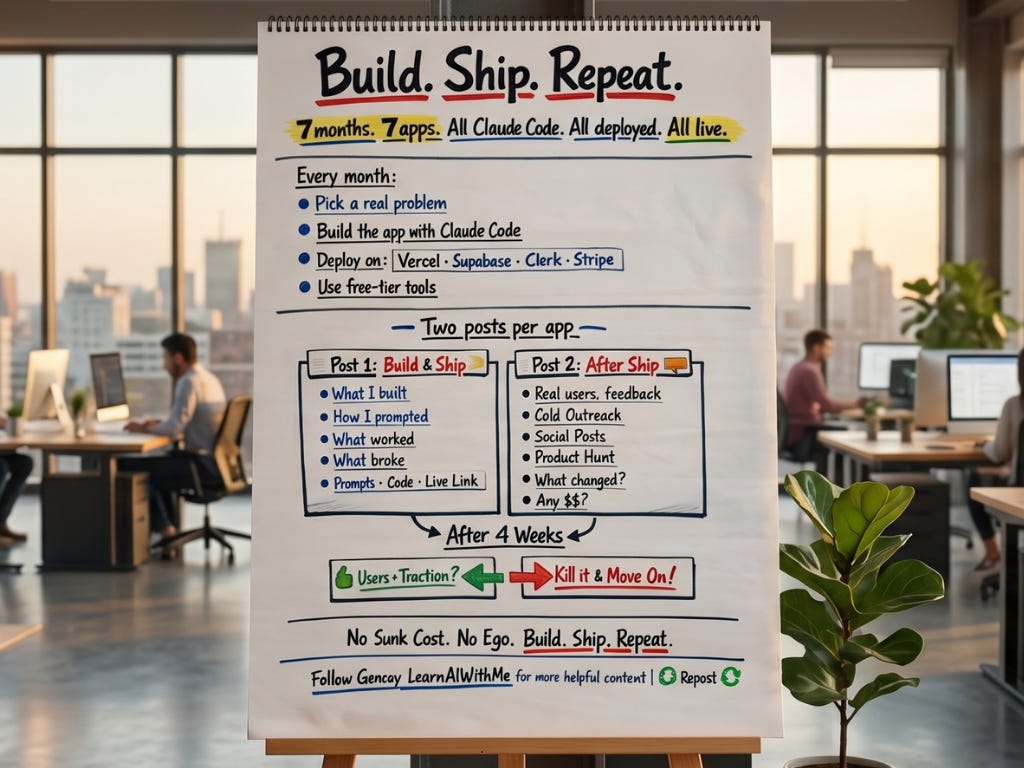
Here’s the commitment:
7 months. 7 apps. All Claude Code. All deployed. All live.
Every month, I pick a real problem.
Something people actually need. I’ll build an app with Claude Code.
I’ll deploy it on Vercel, Supabase, Clerk, and Stripe. Free-tier tools. Production infrastructure.
The same stack real startups use.
Then I’ll write about it.
Two posts per app:
Post 1: Build and Ship. Beginning of the month. I’ll build the app from scratch with Claude Code and deploy it live. What I built. How I prompted. What worked. What broke. The real process, not a polished tutorial. You get the prompts. You get the code. You get the mistakes. And at the end, a live link you can click.
Post 2: After Ship. End of the month. The app has been live for weeks. Now comes the real test. I put it in front of people. Cold outreach. Social posts. Product Hunt. Real feedback from real users. What did they say? What did I change? Did anyone actually pay for this thing? The honest numbers. No vanity metrics.
After 4 weeks, I decide: does this app live or die?
If it has users and traction, it stays.
If not, I kill it and move on.
No sunk cost. No ego.
Build. Ship. Repeat.
Why I’m Doing This
I’ll be honest with you.
I’m also a freelancer. Top 1%. Spent 7000+ hours.
I’ve built AI systems for companies you’ve heard of and companies you haven’t.
But freelancing has a ceiling.
You trade hours for money.
When a client cuts your hours, your income drops.
There’s no leverage. No compound effect.
I want to build things that work without me.
Apps that solve problems while I sleep.
Products that create value beyond my hourly rate.
Claude Code makes this possible. Not because it writes code for me.
Because it lets me build at a speed that turns “side project” into “shipped product” in weeks instead of months.
This series is my proof of concept.
I want to show you it’s possible too.
Two weeks ago, the New York Times profiled a solo founder who used AI tools and $20K to build a telehealth company tracking toward $1.8 billion in revenue.
Two employees. No VC money.
Sam Altman called it: the one-person billion-dollar company is here.
Whether that specific story holds up or not, the trend is real. Solo-founded startups jumped from 23.7% to 36.3% of all new companies on Carta by mid-2025.
The number of people required to build something real is dropping fast.
You don’t need a team. You don’t need funding. You don’t need to quit your job first. One person. Claude Code. Free-tier infrastructure. That’s enough to ship.
And who knows? Maybe one of these 7 apps finds its audience.
Maybe one goes viral.
Maybe one generates enough revenue that I can stop trading hours for money and go all-in on building products and this newsletter.
That’s the real dream. Not 7 apps. Freedom. Together.
Let’s find out.
App #1: Coming on May 1
I’m starting with something close to home.
The first app solves a problem I face every day.
It involves AI agents, orchestration, and making complex systems talk to each other through a clean interface.
That’s all I’ll say for now.
On May 1, you’ll see the build.
The prompts. The code. The live link.
If you want to follow along, subscribe.
Every paid post gives you the full build: working prompts, agent configurations, and deployed apps you can use, fork, or steal.
In plain English.
You learned how to prompt.
Now let’s build.
7000 hours of freelance AI work is solid, but you're right, the real edge is shipping. Spent years in PM at startups and Salesforce; now running my own advisory for B2B SaaS founders. Love this exact problem space.
If you want a second set of eyes on any of these 7 apps (product direction, feature prioritization, GTM angle, user feedback loops), I'm in. No strings. Just think it's a fun way to stress-test thinking on AI applications at scale.
DM me if it lands.
Would it be possible to tag the builds with Build #1, #2, etc., so they are easier to follow? Thx!