
NotebookLM Built My Decision Council (3 Geniuses)
I trained NotebookLM on three books. Built Council with Claude Code. They argue every decision in 12 slides.

How do you make a hard call?
Most of the time, I find myself thinking about the geniuses I look up to. What would they do?
Nikola Tesla was one of the greatest inventors who ever lived. A mind ahead of his century, no doubt.
Marcus Aurelius, who could decide calmly even in storms. A Stoic. The man who put his own actions at the center of everything.
Sun Tzu, who knew how to win without fighting.
But which one? Each shows up for me at different moments.
Tesla told me to go deeper when I wanted to reach more people on Substack,
He would have written a series, AI said once. So I started Build It and Build. Ship. Repeat.
After a great client meeting that went into radio silence, and the anxiety that followed, Marcus Aurelius told me the only thing in this life I can change is my own actions. Only that.
When I wanted to argue with the problematic neighbor whose loud grill smoke was filling our flat, Sun Tzu’s line came to mind: “The supreme art of war is to subdue the enemy without fighting.”
The pattern was clear. I was already running a one-person council. Just badly.
I was rereading the same passages.
Quoting from memory.
Half-remembering chapters.
So I built the Council, using Claude Code Agents. (With one prompt)
Three voices, three books, three rounds of argument, one report at the end.
NotebookLM read the books. It runs the rounds. It builds the Slides, consisting of each voice.
I just read the friction.
The day they argue, I decide.
Not before.
And we’ll do it in 3 steps, together.
Let’s start.
A note before we build
This is the first post of Claude: Build It.
Each post, I hope, will feature how you are running the same use case in your own environment. Different decisions, different books, different stacks.
DM me how you built yours. I’ll feature your version in the next post.
Let’s build it together.
How does the system work?
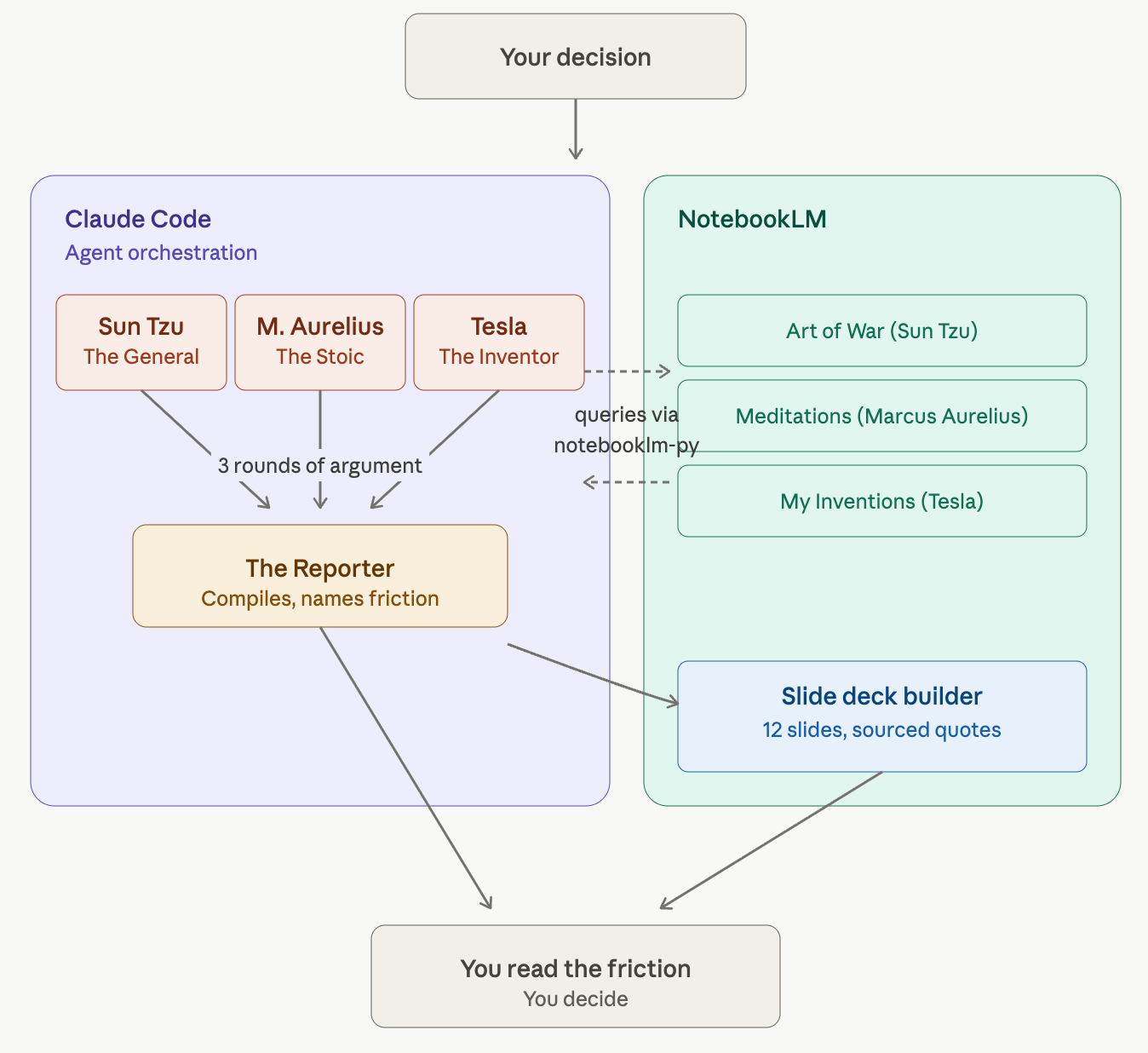
First, Claude Code spins up four agents: three voices and one Reporter.
Each voice (Sun Tzu, Marcus Aurelius, Tesla) queries NotebookLM through the notebooklm-py CLI. Every query hits only its own book. No drift. No blending.
They argue in three rounds. Round 1: initial positions. Round 2: cross-examination. Round 3: final stance.
The Reporter listens to all three. Compiles the transcript. Name the friction.
Then the Reporter sends the deliberation back to NotebookLM. NotebookLM builds a 12-slide deck, one slide per voice per round, plus the friction and the final question.
You read the friction. You decide.
What will the end report look like?
The prompt is yours to adjust. You change the decision. You change the books.
You paste your decision. The system spins up three agents, each one sourced from a single book, each one queried only against its own author.
They argue in three rounds. The Reporter listens, compiles, and names the friction. Then NotebookLM turns the whole deliberation into a 12-slide deck with sourced quotes on every slide.
The final report looks like the slide below.
Each voice gets its own slides. The General lays out his terrain. The Stoic names what is in your control. The Inventor draws the future. Each slide cites the chapter the quote came from.
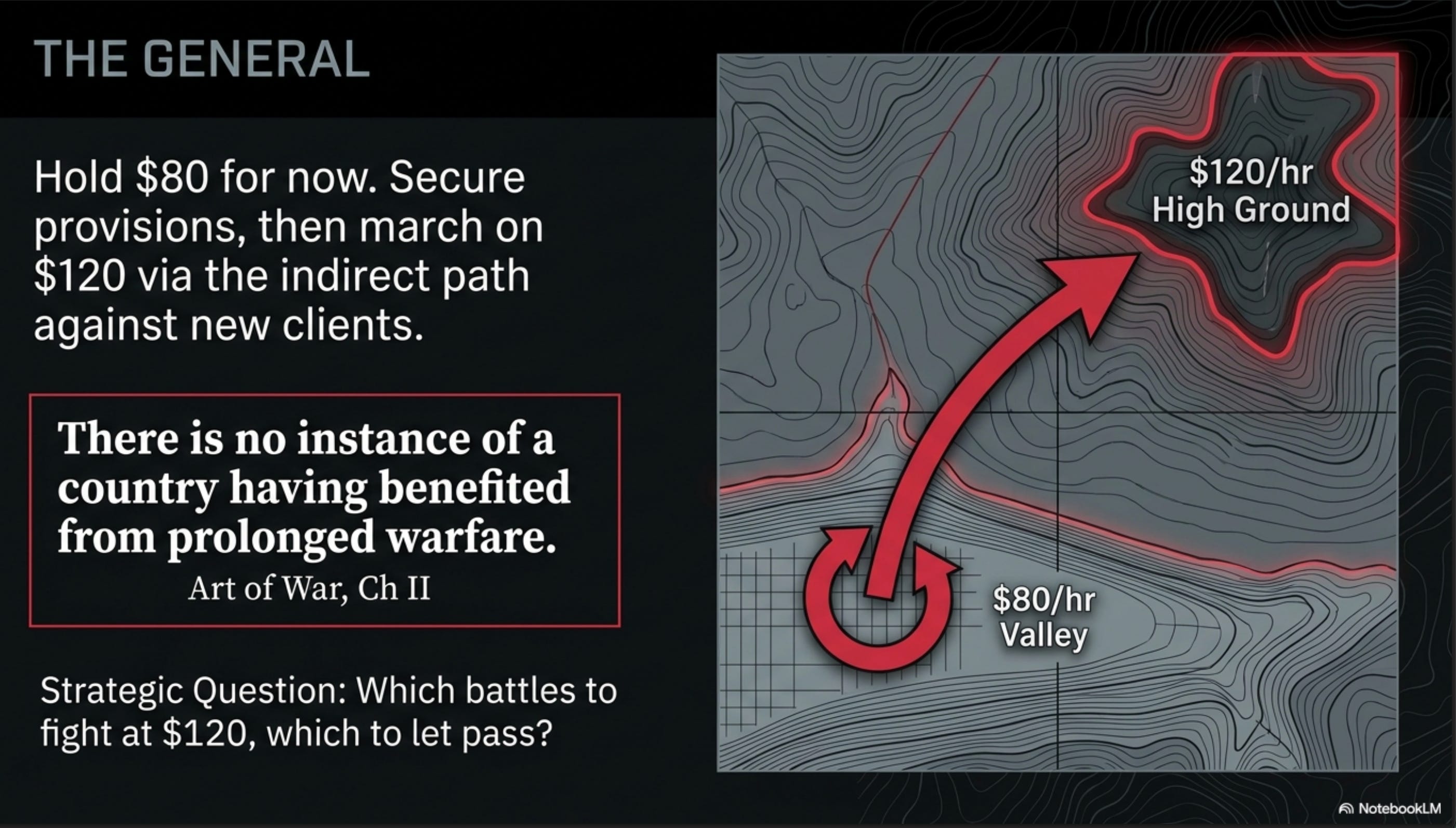
Three voices. One report. A decision that has been argued before it reaches you.
The Council waits. Build it.