

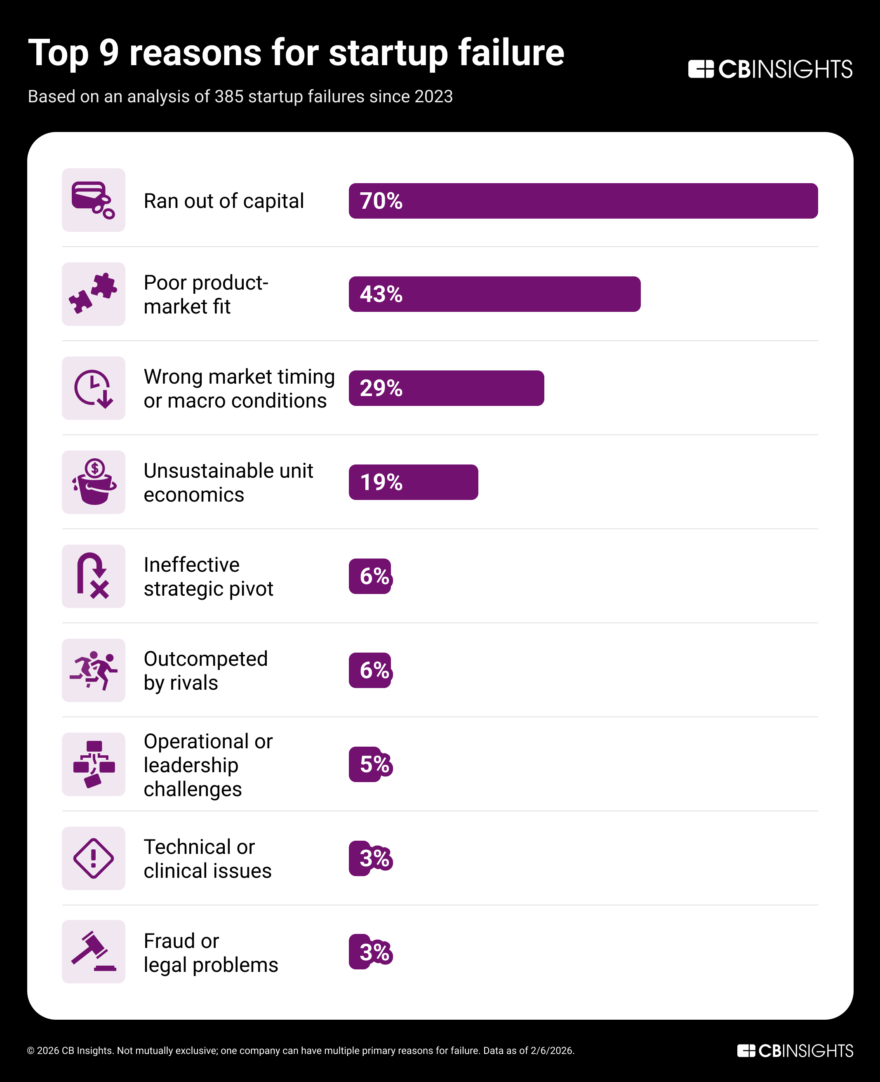
90% of AI startups never hit 6 figures.
CB Insights tracked the autopsy of 385 of them.
43% died from poor product-market fit.
So, how do you actually fit a product into the market?
Most founders guess.
They pick an idea that feels right, build for 6 months, then find out nobody wanted it.
What if we built a NotebookLM trained on every recent AI startup (Product Hunt launches, Y Combinator batches), what investors say they want to fund (a16z, Sequoia memos), and why dead startups died (failure post-mortems)?
Then sent Claude agents inside to hunt for gaps?
So I built an architecture.
NotebookLM is the knowledge layer. Three Claude Code agents as the team.
10 rounds of adversarial argument. One survivor.
Let me show you the architecture.
The Architecture of What We’ll Build
The architecture has 3 layers.
Layer 1 holds the knowledge, which is NotebookLM, good because of less hallucination.
Layer 2 is the Claude agents, querying NotebookLM.
Layer 3 is a loop, entire process will last 10 rounds.
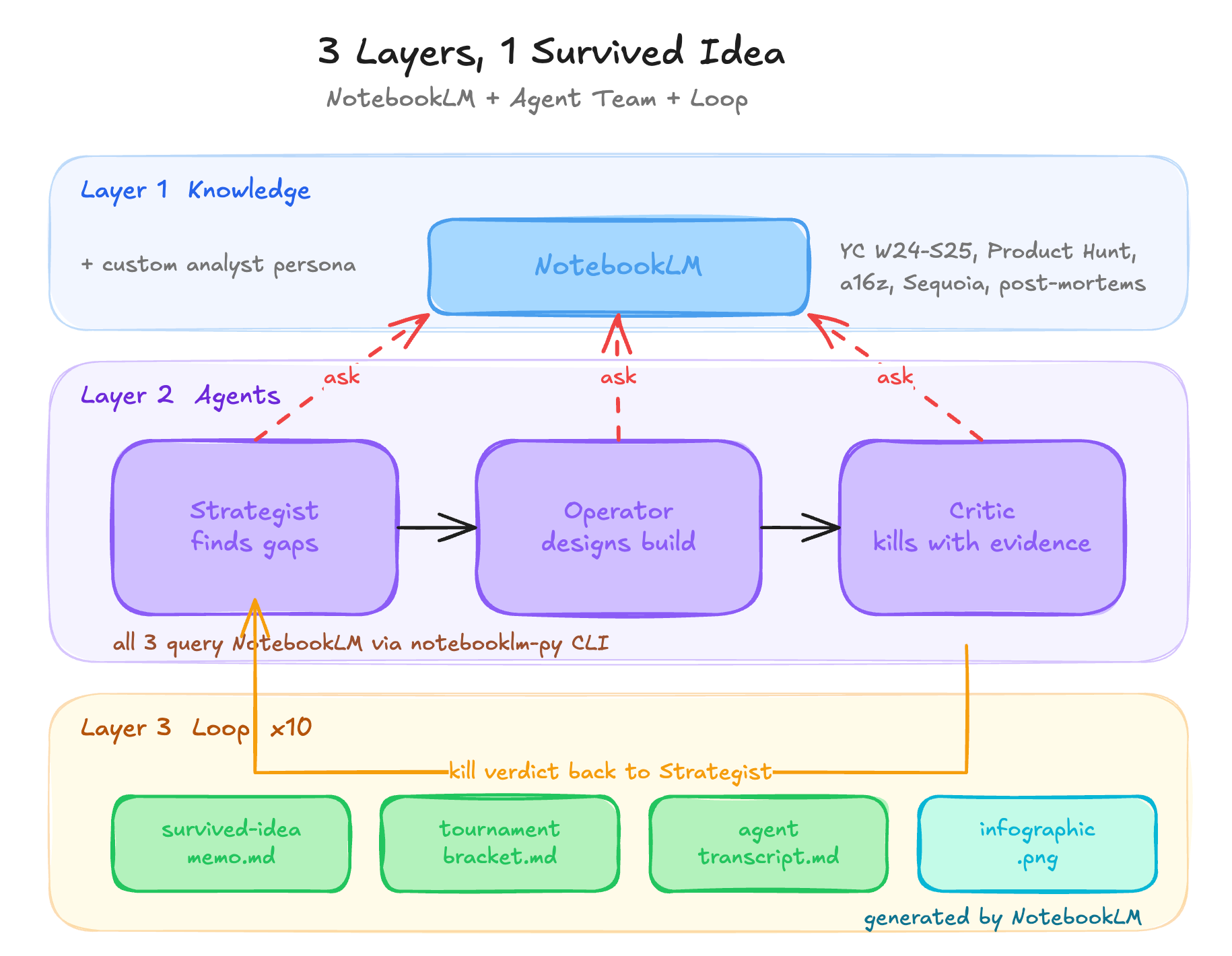
Let’s look closer at each layer.
Layer 1: Knowledge
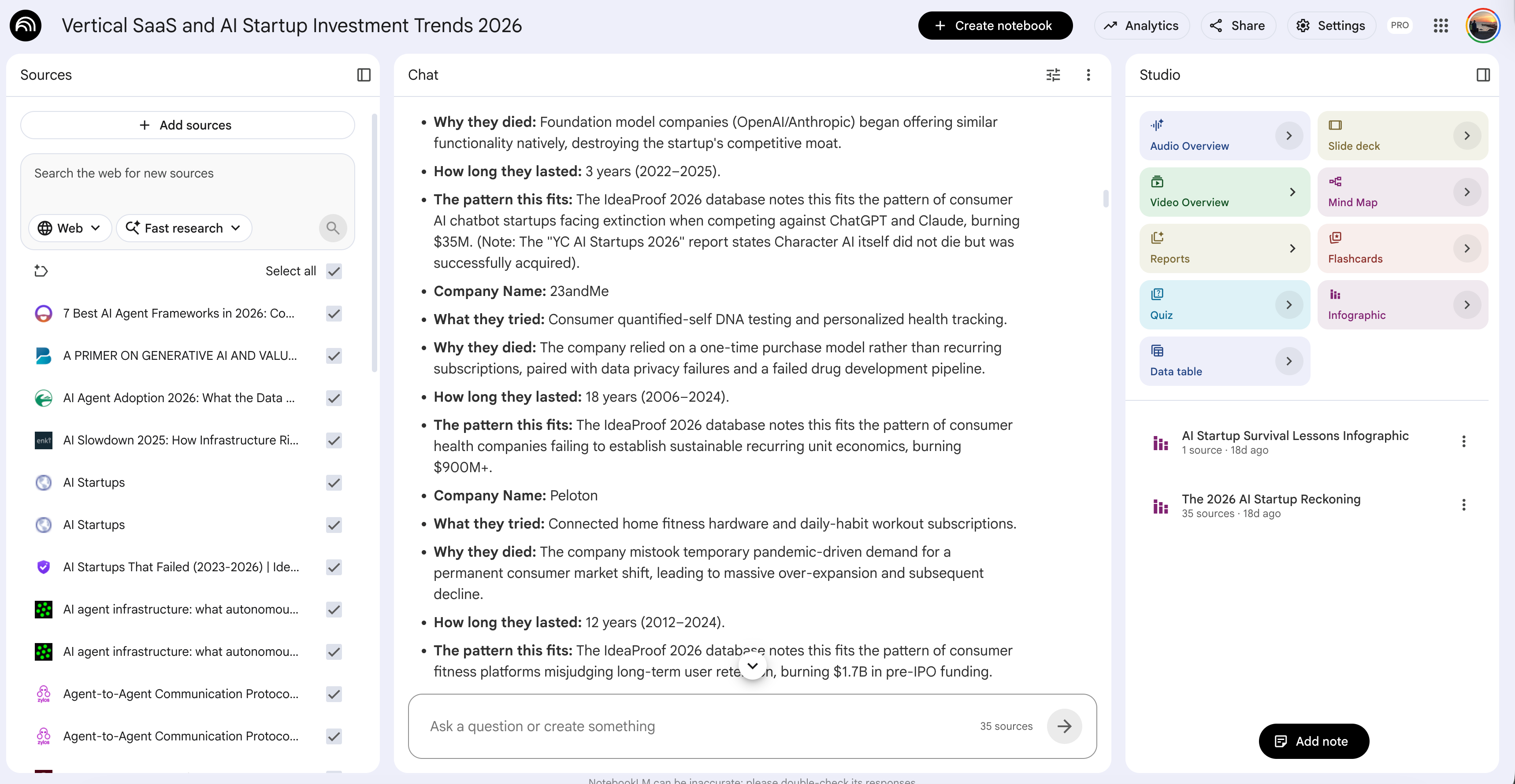
At layer one, we’ll train a NotebookLM, using a deep search prompt.
The only thing you’ll do is paste this prompt and be done.
This will be our single source of truth.
I picked NotebookLM because it hallucinates less. It only answers from the sources you give it.
That makes it a good brain.
Here is what we’ll add and why.
YC W24 through S25 batches. This means the most recent funded AI companies. If an idea is already here, it is not a gap.
Product Hunt launches from 2024 to 2026. Which means what the market actually upvoted. The gap between YC and Product Hunt is where the Strategist hunts.
VC theses from a16z, Sequoia, First Round. Which means what investors say they want funded, and what they say is crowded.
Post-mortems from Failory and Indie Hackers. Which means dead startups with written autopsies. The Critic uses this to kill ideas with evidence.
Funding rounds from Crunchbase and TechCrunch, 2024 to 2026. Which means recency. A fresh Series A is a different signal than a 2023 round.
Layer 2: Agents
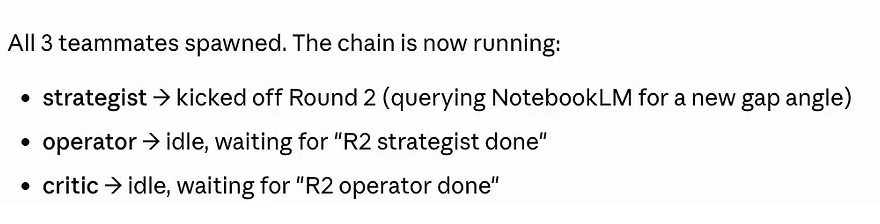
At layer two, we’ll spawn 3 Claude Code agents.
They will work as a team.
I picked 3 agents because one agent agrees with itself.
The only thing you’ll do is paste this prompt and the agent team will be spawned.
Two agents pick a winner too fast. Three agents force a real argument.
Strategist. Which means the gap finder. It queries NotebookLM for unbuilt categories, underfunded angles, and capability gaps. It proposes one idea per round, because more than one idea per round means none of them get tested.
Operator. Which means the build designer. It takes the Strategist’s idea and turns it into a real spec. Stack, MVP scope, pricing, and first 3 customer segments. Tactical stuff. Numbers over adjectives.
Critic. Which means the killer. It queries NotebookLM for dead companies, failed categories, and structural reasons. This idea won’t work. Brutal, evidence-driven, no diplomacy.
Then we’ll add a coordination rule.
Each agent queries NotebookLM directly through the notebooklm-py CLI.
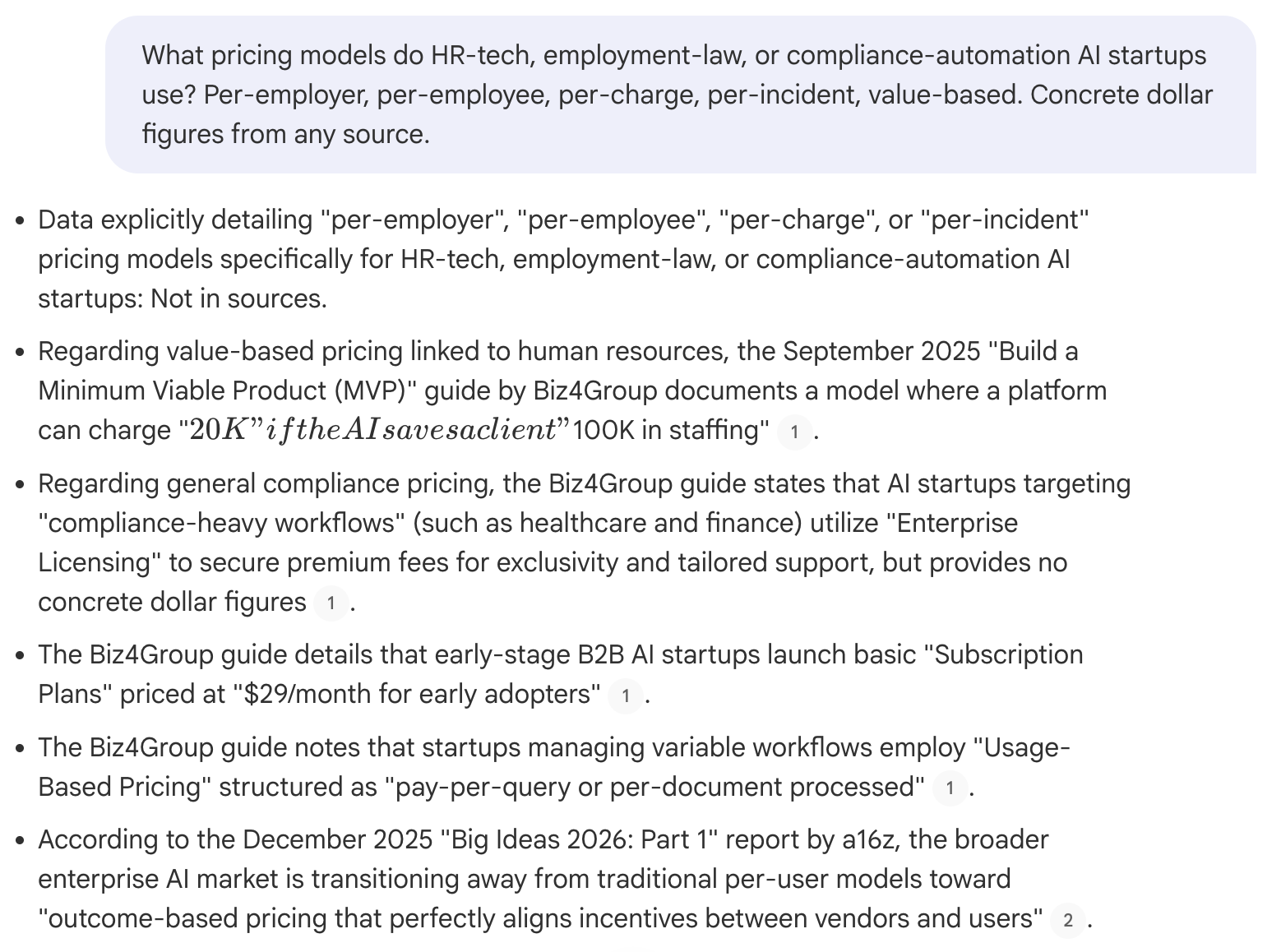
The best part? If the answer to the question is not in the source, it won’t answer.

This means less hallucination.
They each go to the source.
Layer 3: Loop
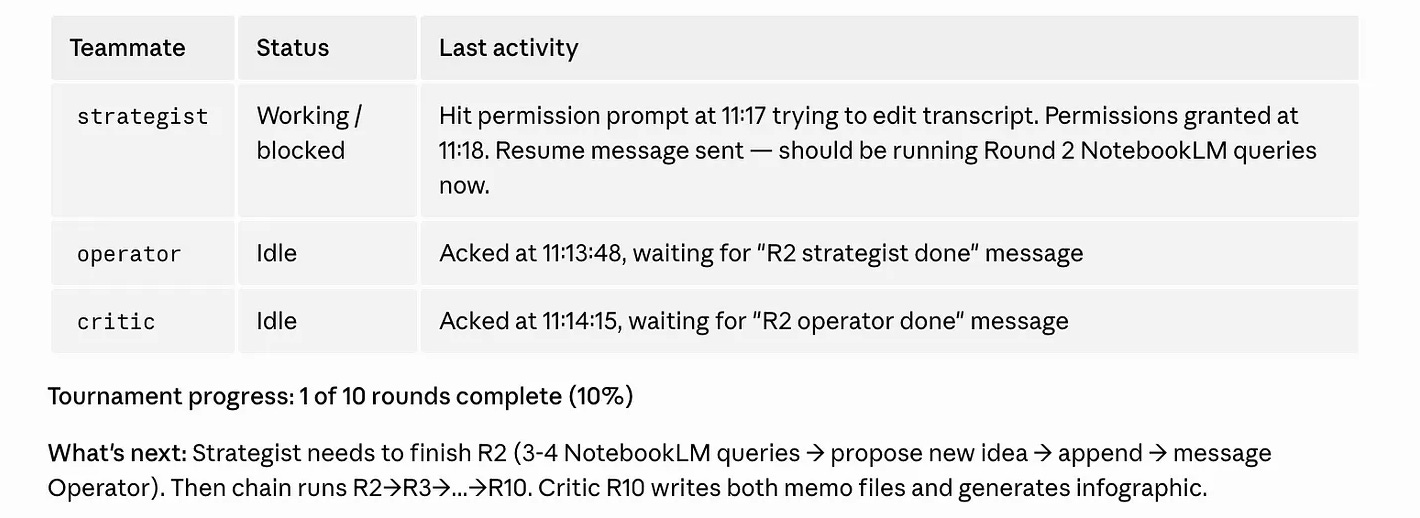
At layer three, we’ll wire the agents into a loop. 10 rounds. Same order every round.
I picked 10 rounds because 3 is too few to kill a stubborn idea, and 20 sharpens nothing new.
By round 10, either an idea survives every kill angle or nothing in that branch will.
Here is how one round runs and why.
Strategist → Operator → Critic. Which means propose, design, kill. In that order. The Strategist can’t see the Critic’s verdict until the Operator has already built the spec. This stops the Strategist from softening the idea to dodge a kill it can already smell coming.
Critic’s verdict feeds the next round. Which means round 2’s Strategist starts by reading round 1’s kill reason. The next idea has to address that exact failure. No pretending the kill didn’t happen.
The new idea must be meaningfully different, not a tweak. Which means if round 1 died because “no SMB will pay for this,” round 2 can’t propose the same idea with cheaper pricing. It has to find a different gap. The Strategist tracks used angles in a list and can’t reuse one.
After round 10, the agents write 3 files. The surviving idea memo. The tournament bracket. The full transcript. Then they tell NotebookLM to generate an infographic from the bracket file. One command, one PNG.
That is the loop. The strategist proposes. Operator builds. Critic kills. Repeat 10 times. Whatever lives is what gets shipped.
What will be the result?
You’ll get an infographic explaining your winning idea.
The infographic comes from NotebookLM. It reads the tournament bracket file and renders it into one image. Champion at the top.
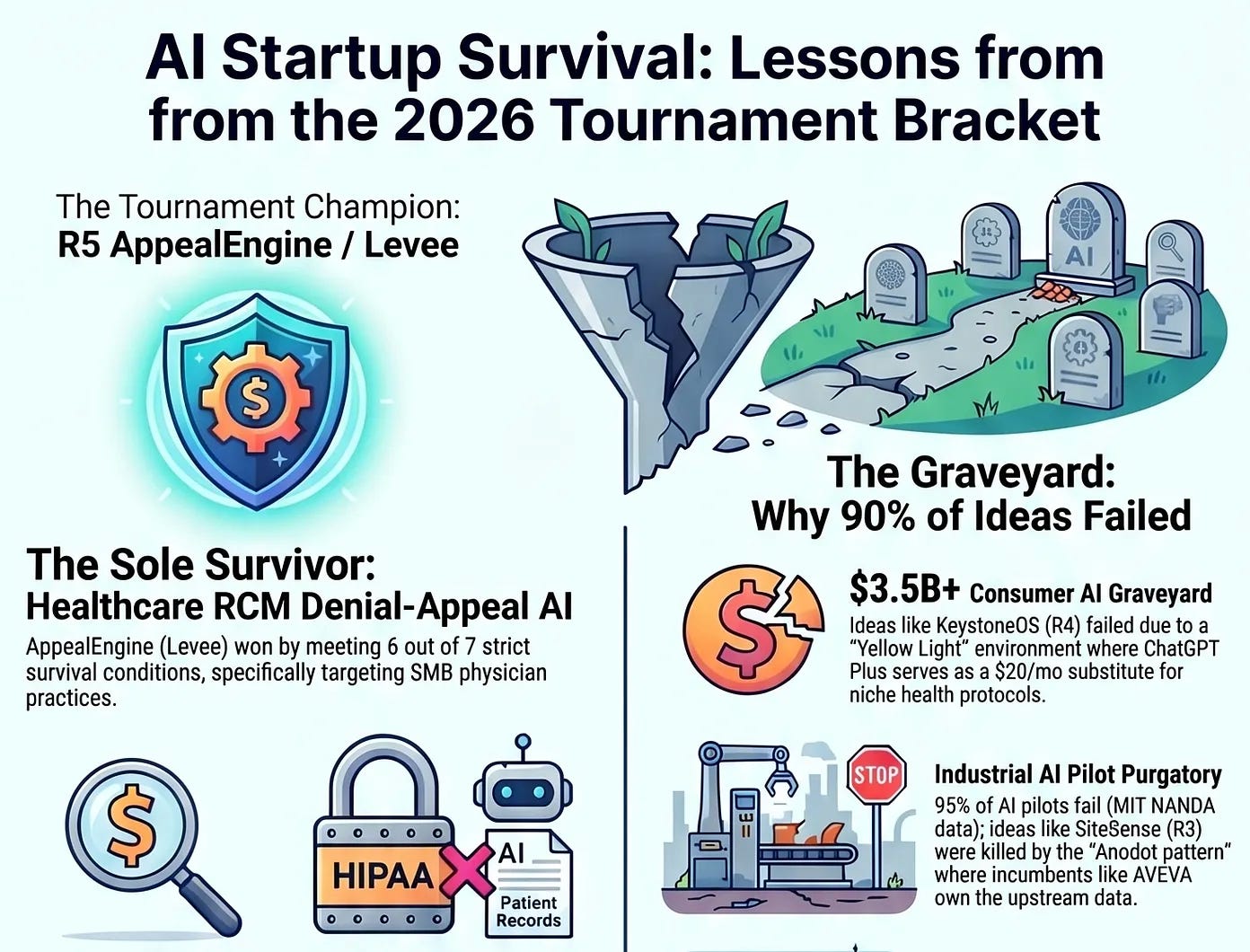
And with a minor tweak, you can see how the ideas were generated and fought.
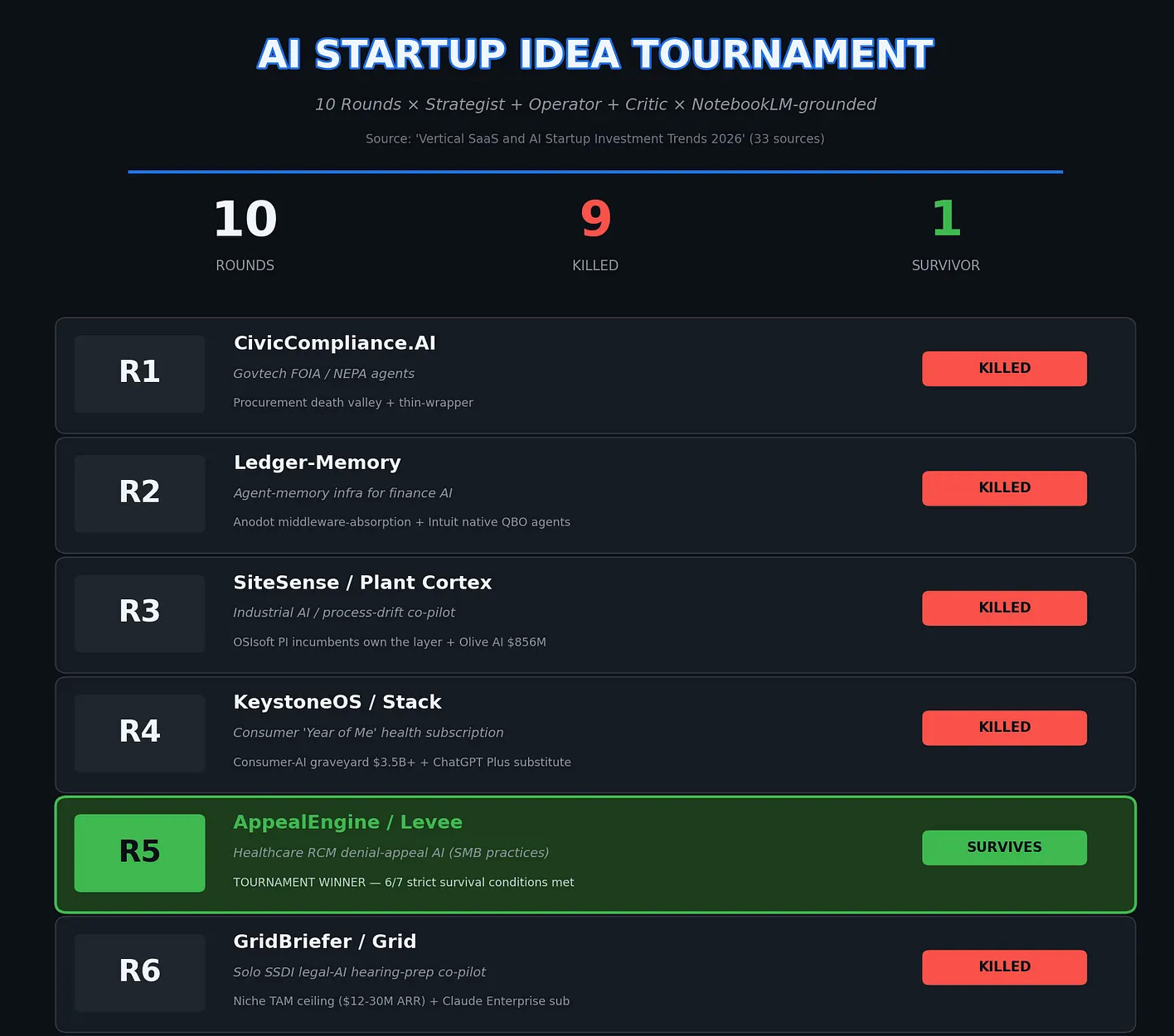
This one is a different view. Same data. We asked Claude to draw the full bracket from the transcript, not the NotebookLM summary.
10 rounds. 9 killed. 1 survivor.
Each row shows which round killed which idea, so you can see the pattern across the tournament.
Two outputs from the same tournament. The NotebookLM infographic is the executive summary. The Claude bracket is the receipt.
Let’s start training the NotebookLM first, using only one prompt.
Step 1: NotebookLM
I trained a NotebookLM with this prompt.