
I Analyzed 11 Substack Writers' Notes. Here's What They Do Differently
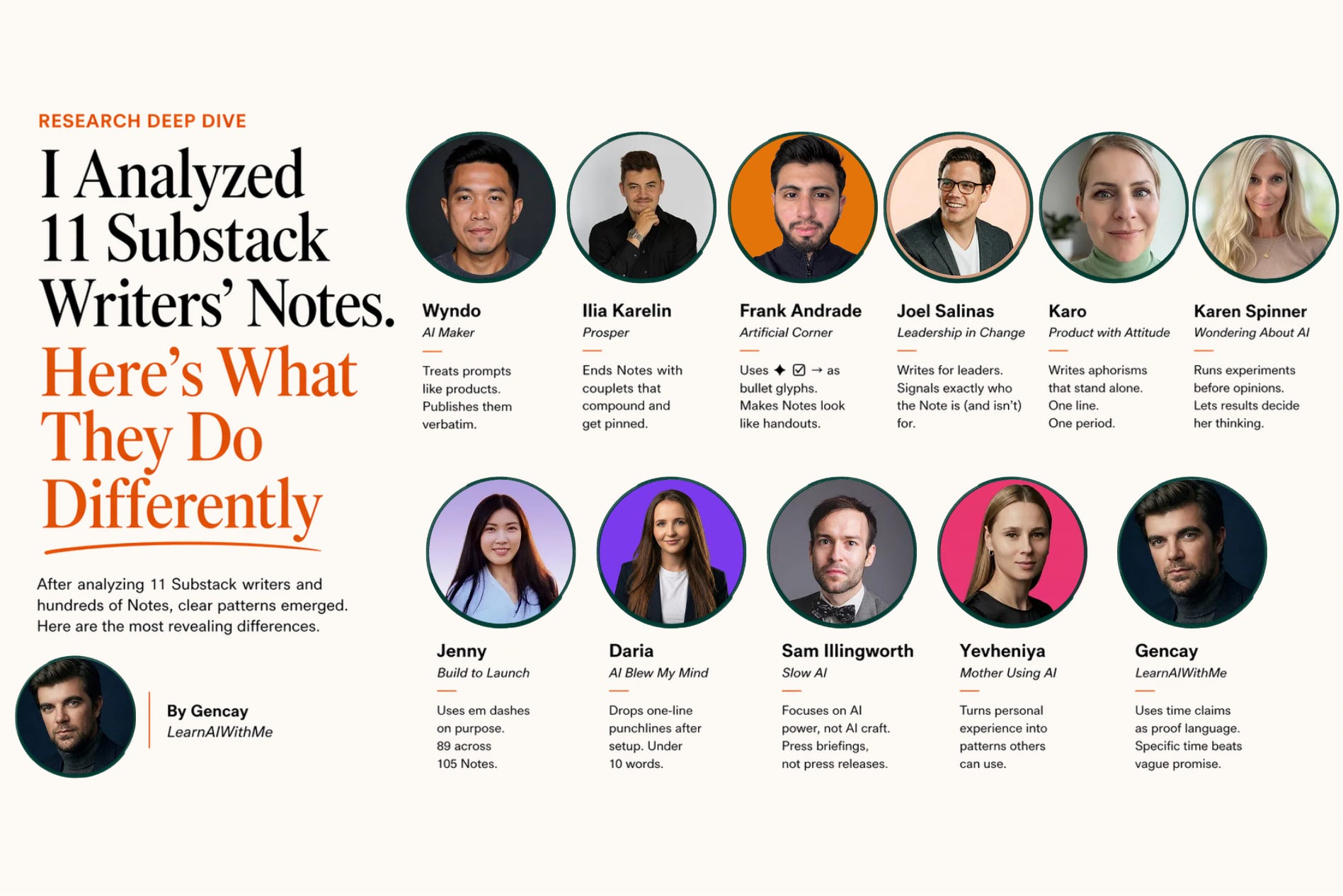
I extracted every Note from 11 top AI Substack writers and reverse-engineered their patterns. Here's the DNA behind each voice, plus a Claude Artifact that writes in their style.


Notes is where most Substack writers waste their time.
Everyone posts. Few convert. The ones who do convert follow a pattern most people never see, because they’re too busy writing their own Notes to study anyone else’s.
I spent a week reading Notes from 11 writers I respect →
Not the kind of reading where you scroll and double-tap.
The kind where you open the HTML, extract every Note, and ask what makes this person’s Notes recognizably theirs.
Eleven writers. All in the AI and tech space.
All actively posting. Some have 50K subscribers, some have 200.
Here’s what I found. Each writer has a Note DNA.
Similar to this →
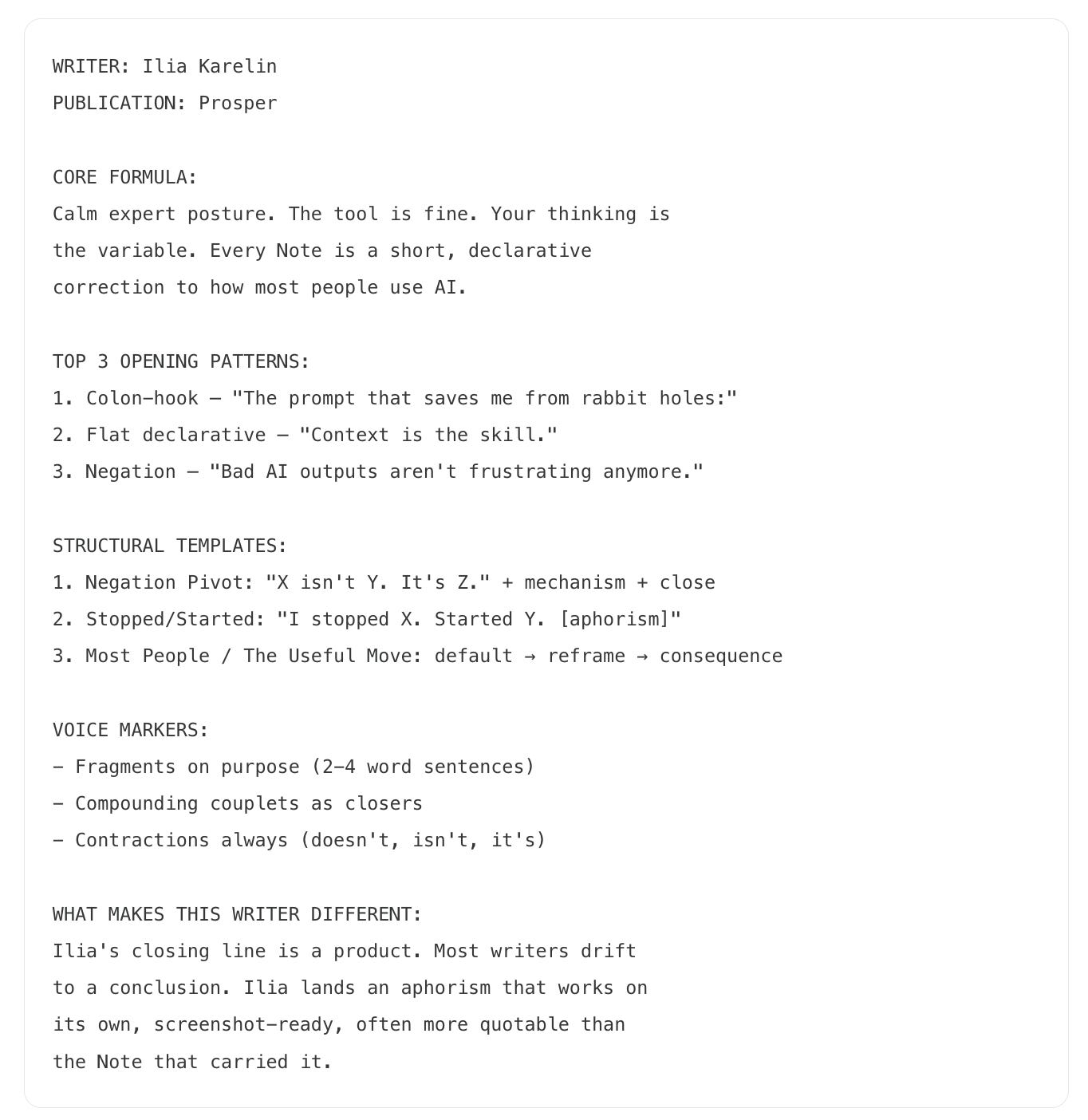
A small set of formulas they run on repeat.
Once you see it, you can’t unsee it.
And once I saw it, I built something.
For every writer on this list, there’s a Claude Artifact at the end of their section.
Similar to this →
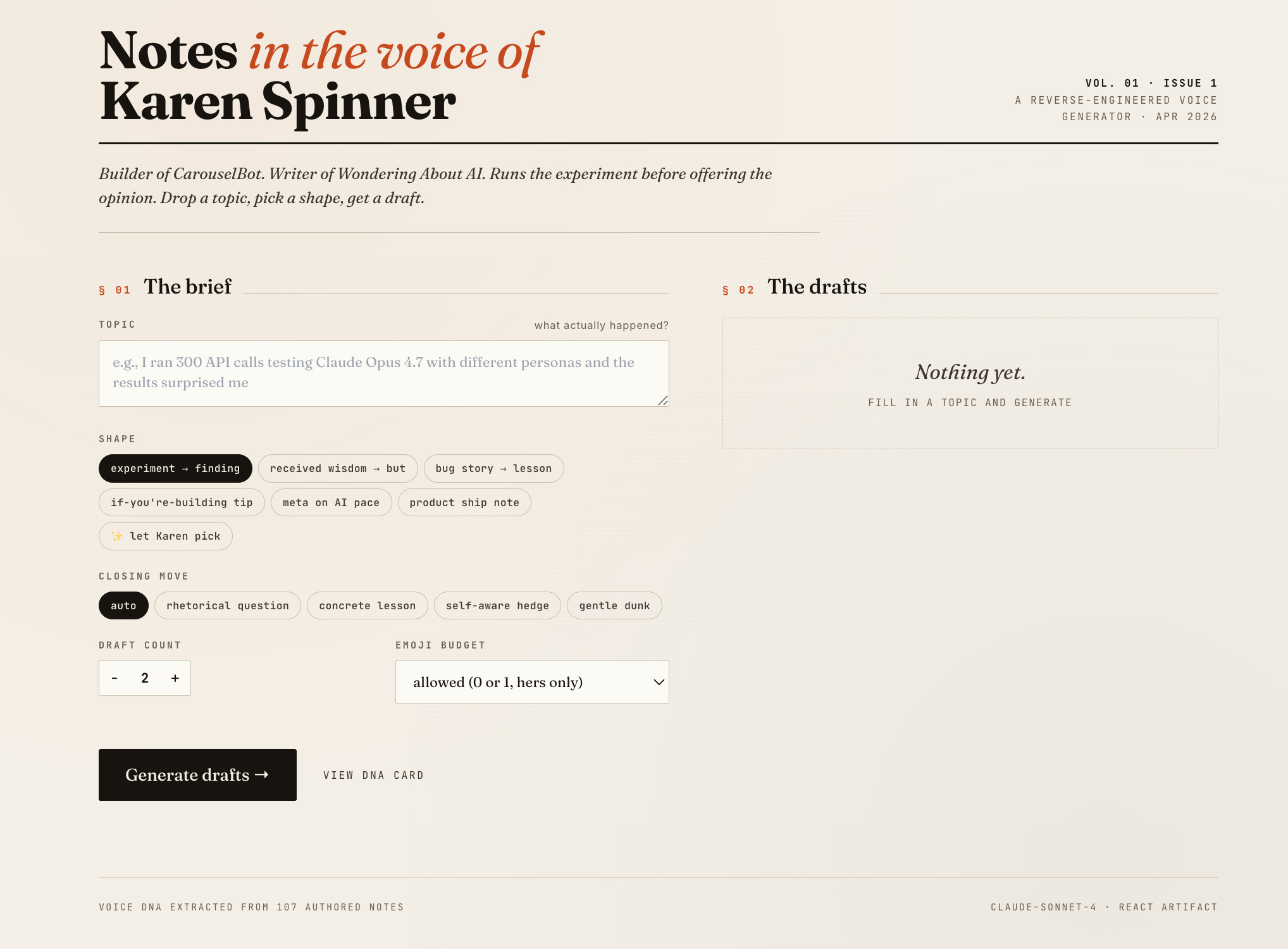
You type a topic, pick one of their structural templates, and the artifact produces a Note in that writer’s voice.
A Note that respects their rhythm, their openings, their quirks.
Similar to this →
Try one.
Then go read the real writer’s Notes and see the difference.
But first, let me explain the methodology.
The Methodology
We’ll do it in two simple steps.
Step 1- Data Collection
Go to the writer’s Substack page.
Let’s start with Wyndo, visit his page.
And scroll down 30 days. (Takes 5-6 minutes)
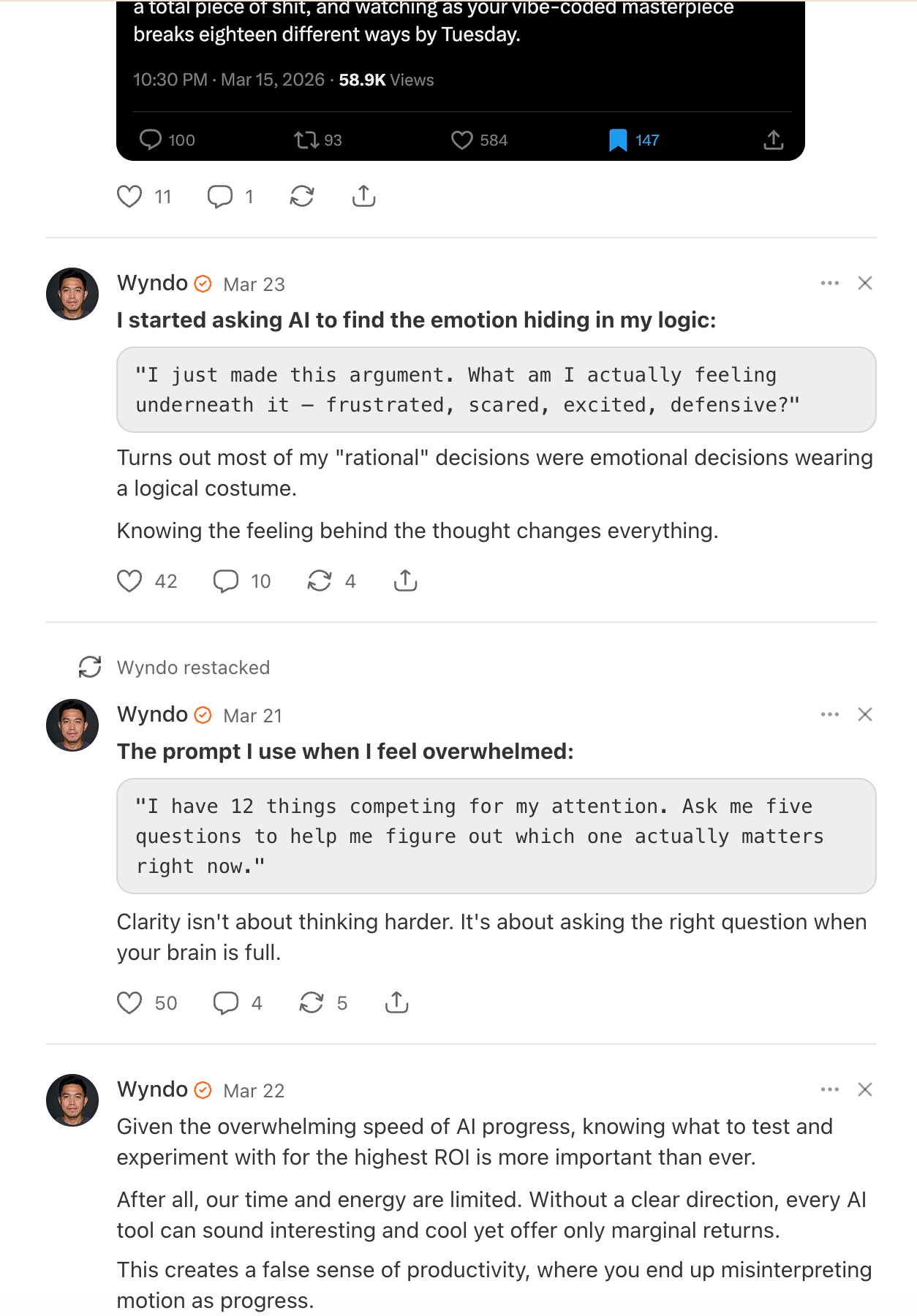
Now, right-click and click on “Save as”.
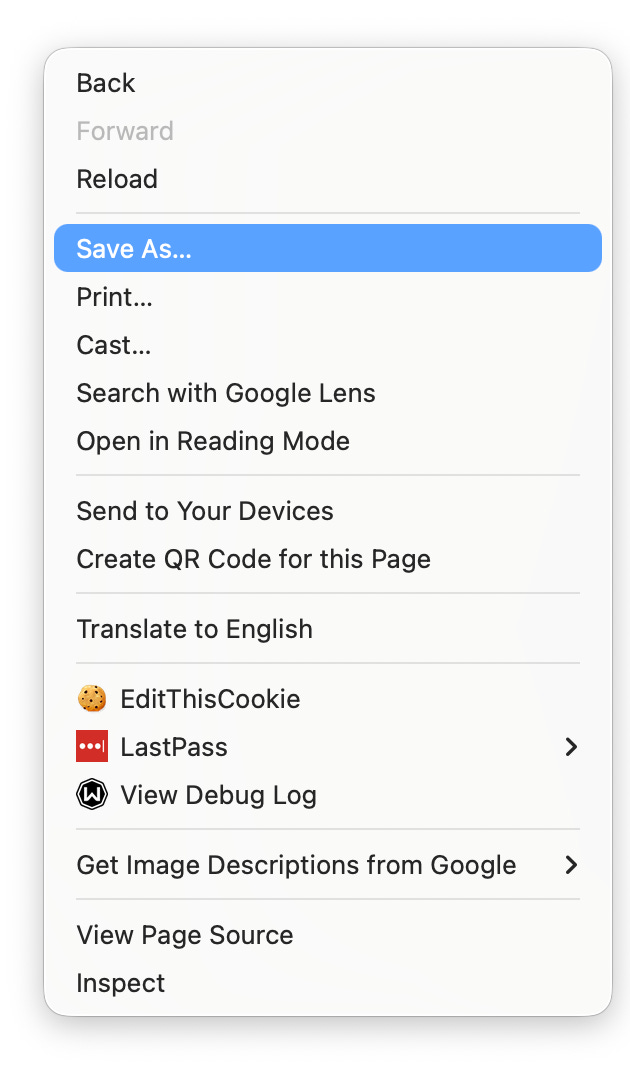
And save as wyndo-substack.html.
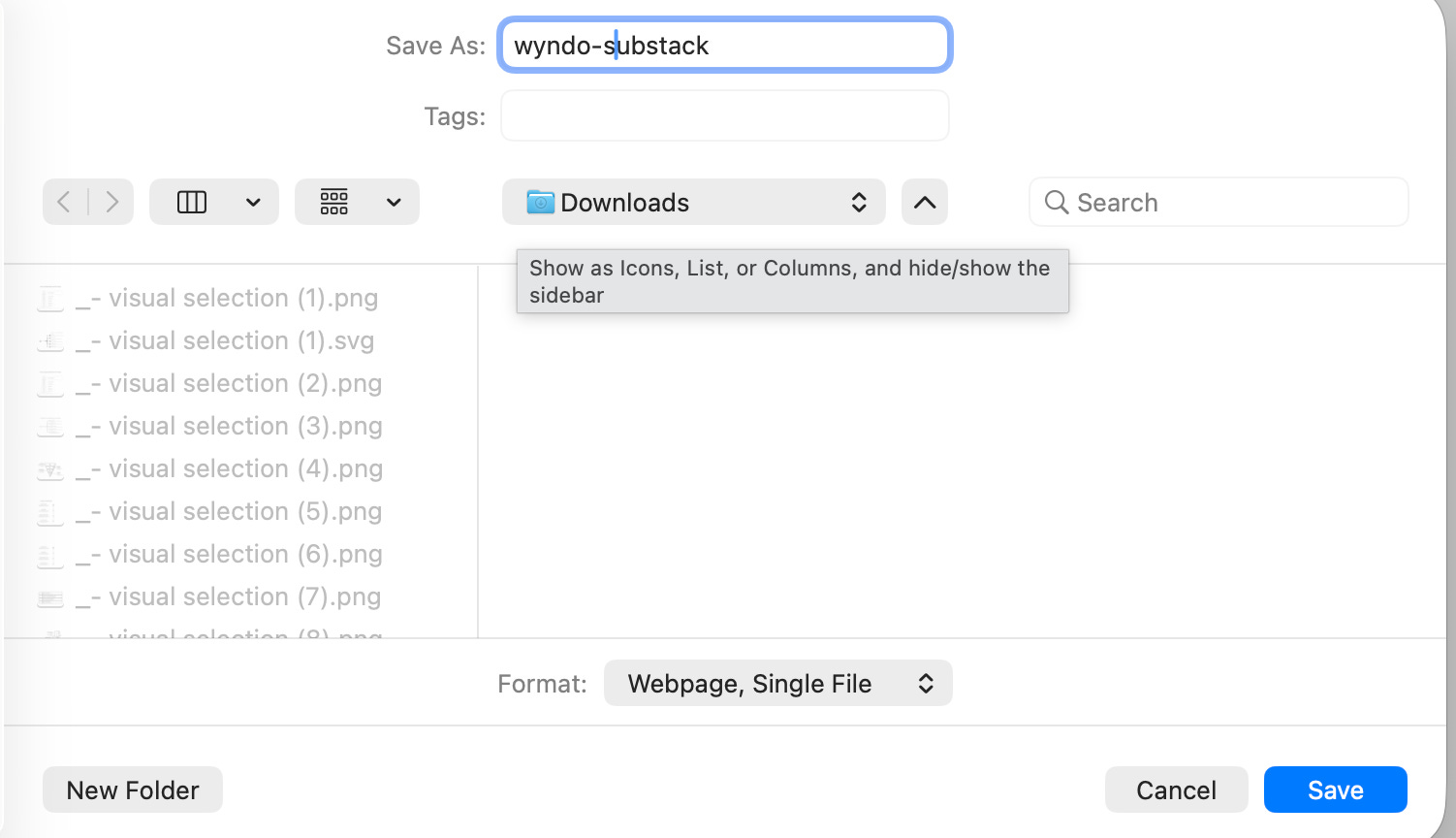
Step-2: Analyze with AI and Create an Artifact
Now let’s analyze with AI and build an artifact.
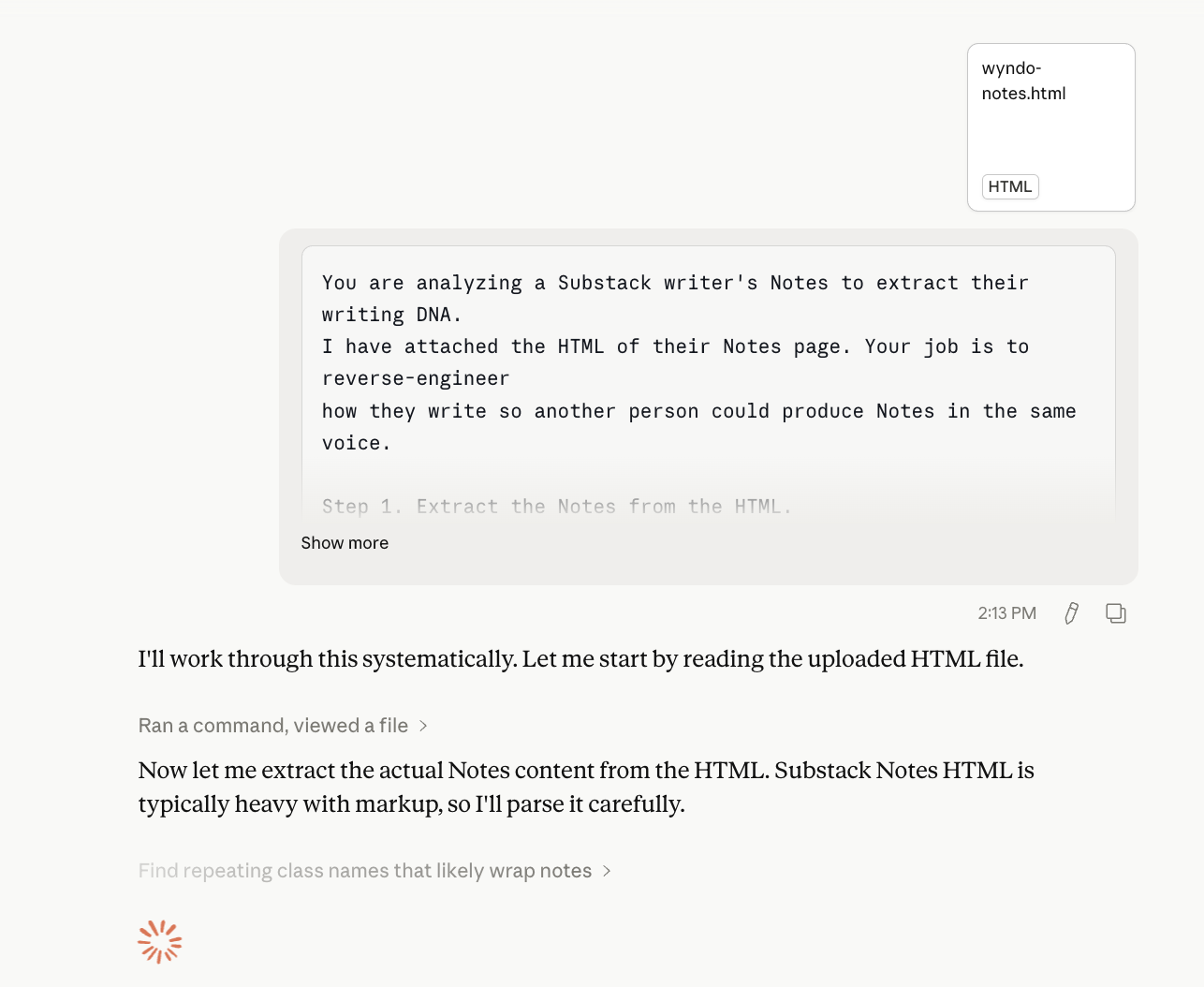
Open a new chat in Claude, attach this HTML, wyndo-substack, and paste this prompt.
You are analyzing a Substack writer's Notes to extract their writing DNA.
I have attached the HTML of their Notes page. Your job is to reverse-engineer
how they write so another person could produce Notes in the same voice.

Step 1. Extract the Notes from the HTML.
Step 2. Analyze opening patterns, sentence rhythm, structural formulas,
        topic territory, voice markers, and what they avoid.
Step 3. Produce a DNA card in a fixed format.
Step 4. Build a single-file HTML artifact that generates Notes in this
        writer's voice, using the Anthropic API.

Output all four in full. Do not skip steps.
And the analysis has started.
Let’s see how Wyndo writes such good Substack notes.
1. Wyndo — AI Maker

Wyndo writes about AI the way a carpenter talks about wood. He's interested in how it behaves, not how it looks on camera.
What I noticed: Wyndo treats prompts like products. He publishes them verbatim, in quotes, as if they’re the artifact.
The Extraction
The script pulled 203 Note containers out of the HTML.
After stripping Substack’s chrome, video controls, timestamps, and “Latest post” cards, 172 of them were real voice Notes.
The other 31 were podcast embeds and post promotions.
172 is a big enough sample to trust. Here’s what came out of it.
Wyndo’s Shape
Median length: 53 words.
Most common structure: 5 lines. 40% of his Notes are exactly five lines long. Another 14% are six.
Line length: 8 words on average. Almost half his lines are under 7 words. He treats every new line like a complete sentence. Capital letter to start, period to end.
Openers: 25% start with “I”. 20% start with “The”. Almost half of everything he writes begins with one of those two words.
Closers: A declarative principle. Something under 10 words that reads like a screenshot waiting to happen. He almost never ends on a question.
The 5-Line Skeleton
After reading 172 Notes, one pattern kept repeating. This is the shape:
L1  Hook with colon at the end
L2  A verbatim prompt in quotes
L3  Why it works — the mechanism
L4  The wider principle
L5  A maxim under 10 words
That’s it. 37% of his Notes use this exact structure.
Once you see it, you can’t unsee it.
What He Avoids
Em dashes. 172 Notes, 8 em dashes. He wants a clean copy that doesn’t look AI-generated.
Hashtags. At-mentions. Numbered lists. “Hot take” framing. Generic engagement bait like “DM me” or “comment below”.
He doesn’t screenshot his ChatGPT conversations. He quotes the prompts directly. The prompt is the object, not the AI response.
No self-deprecation. No false modesty.
He writes from earned authority, and the Notes read that way.
DNA Card
WRITER: Wyndo
PUBLICATION: AI Maker

CORE FORMULA:
Teach people to think with AI, not outsource to it.
Every Note is a portable upgrade: a prompt, a practice,
or a frame the reader can use tomorrow.

TOP 3 OPENING PATTERNS:
1. Colon setup — "The prompt that changed how I decide:"
2. First-person pivot — "I stopped doing X and started Y"
3. Twist reveal — "It's not about the tool. It's about..."

STRUCTURAL TEMPLATES:
1. Colon-Prompt: hook with colon, verbatim prompt,
   mechanism, principle, maxim
2. Pivot: "I stopped / started" or "Instead of / I"
3. Twist: thesis, "It's not X. It's Y.", portable restatement

VOICE MARKERS:
- Straight quotes (not curly) for prompts
- Every line capitalized, every line a full sentence
- Specifics over adjectives (four weeks, ten times, saves
  me hours — not "a lot" or "recently")

WHAT MAKES THIS WRITER DIFFERENT:
Wyndo is one of the only writers who publishes prompts
as the product. Not screenshots. Not paraphrases. The
actual prompt, in quotes, as the Note itself. That move
is his signature.
Try the Artifact
Pick a template. Type a topic. See what comes out.
Then go read Wyndo’s actual Notes and like&restack the ones you like, and compare.
Here is the link to the artifact, trained on Wyndo’s Notes.
Here's how it works.
2. Ilia Karelin — Prosper
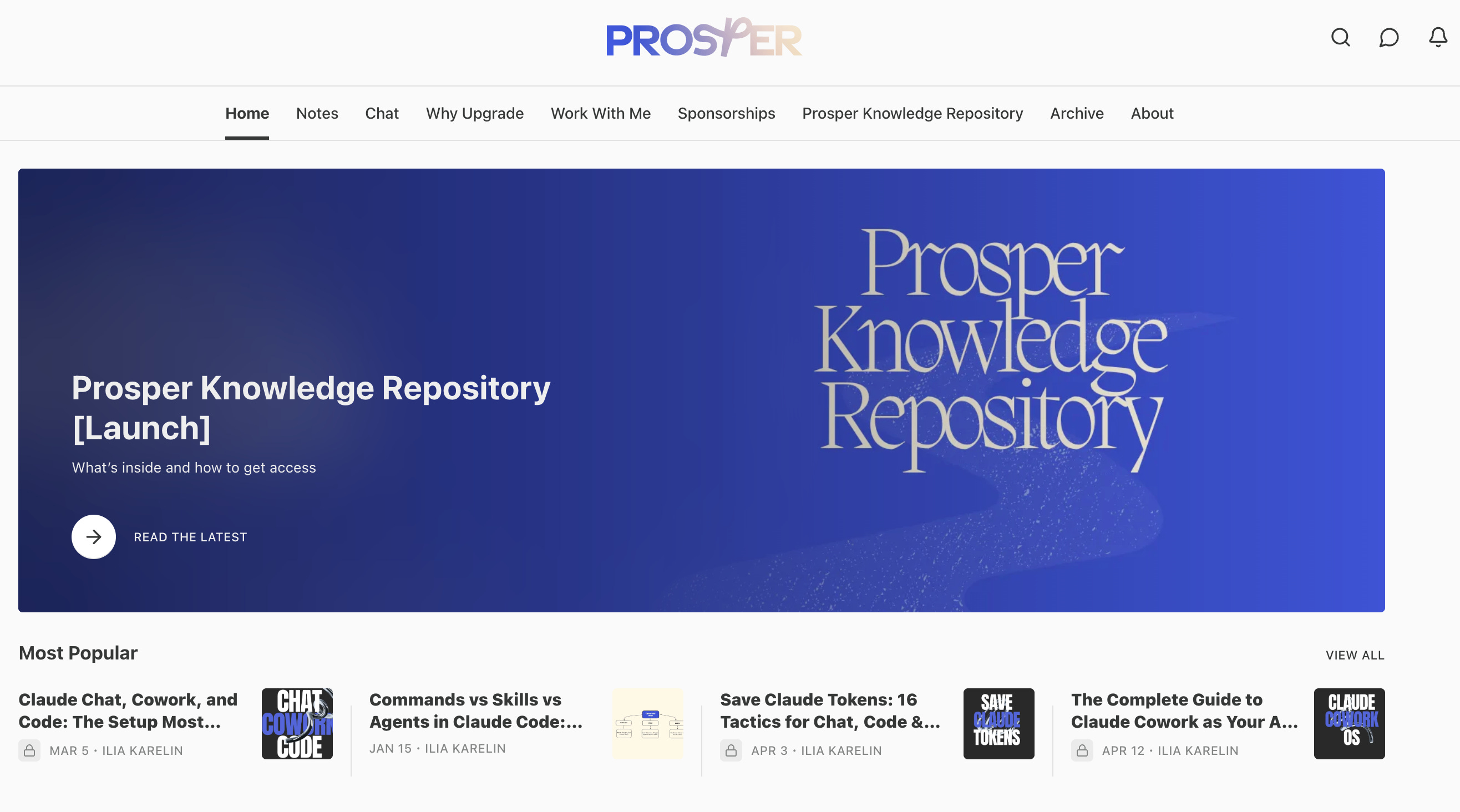
Same steps I followed.
Step 1: Go to Illia
Step 2: Scroll down 1 month.
Step 3: Save it as HTML.
Step 4: Go to Claude.ai and paste the master prompt, which is:
You are analyzing a Substack writer's Notes to extract their writing DNA.
I have attached the HTML of their Notes page. Your job is to reverse-engineer
how they write so another person could produce Notes in the same voice.

Step 1. Extract the Notes from the HTML.
Step 2. Analyze opening patterns, sentence rhythm, structural formulas,
        topic territory, voice markers, and what they avoid.
Step 3. Produce a DNA card in a fixed format.
Step 4. Build a single-file HTML artifact that generates Notes in this
        writer's voice, using the Anthropic API.

Output all four in full. Do not skip steps.
Here is what it looks like.
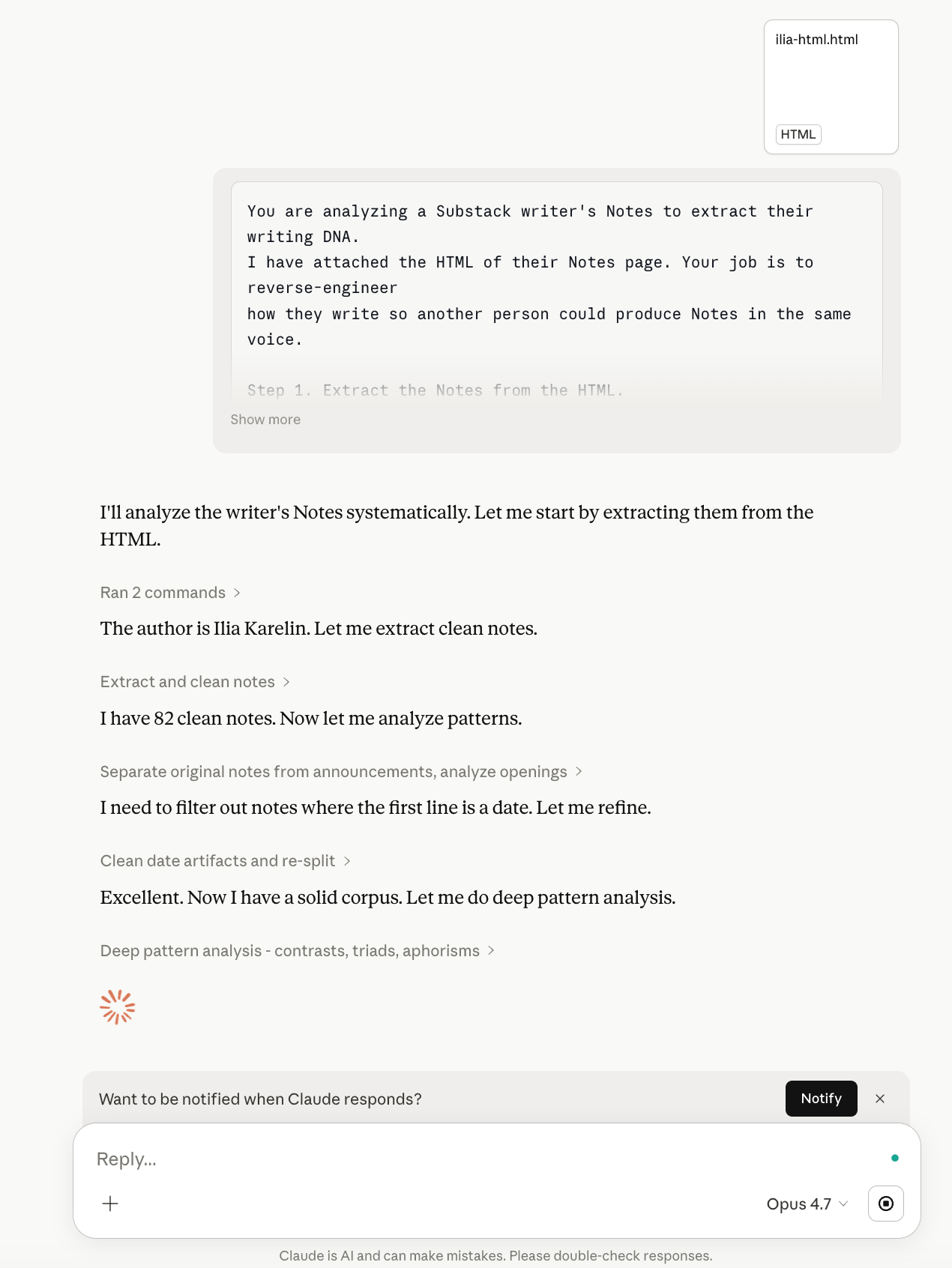
And the analysis finished, let me summarize for you.
Ilia writes about AI tools.
His Notes are almost entirely about Claude, Cowork, Dispatch, and prompting.
He stays in his lane and sharpens it every week.
What I noticed: Ilia ends Notes with couplets that compound. “Output is temporary. Clarity compounds.” “Depth beats novelty.” 1 in 3 of his notes close with something you could screenshot and pin.
The Extraction
The script found 92 Note anchors in the HTML. After stripping Substack’s chrome and filtering out “new post” announcements, 71 original Notes remained. 11 were link broadcasts, not voice writing.
71 is a smaller corpus than Wyndo’s, but Ilia’s patterns are so repetitive that 71 is enough. Possibly more than enough.
Ilia’s Shape
Average length: 41 words. Shorter than Wyndo.
Lines: 4-5 per Note.
Here’s the detail that separates him from everyone else on this list. 32% of his sentences are 4 words or fewer.
That’s not a rhythm. That’s a signature.
The shape looks like this:
Short. Short. One longer line for texture. Short. Close shorter.Fragments are on purpose. “Taste isn’t.” “Every time.” “Just one.” He treats a two-word sentence the same as a ten-word one.
The Negation Pivot
The move he runs more than any other is the negation pivot. “X isn’t Y. It’s Z.”
Examples from his actual Notes:
“The best AI skill isn’t prompting. It’s editing.”
“AI won’t fix a vague goal. It’ll help you pursue the wrong thing faster.”
“Claude Code doesn’t make you a better developer. It makes your current thinking faster.”
25+ of his 71 Notes use this structure.
That’s 35%.
When you read him long enough, you can feel the pivot coming before it lands.
The Aphoristic Close
Ilia doesn’t end on a question. He ends on a couplet.
“Output is temporary. Clarity compounds.”
“Constraints beat aspirations every time.”
“Habit beats hype.”
“Depth beats novelty.”
“Better questions lead to better answers.”
The closing line is always shorter than the average sentence in the Note. It earns the last word by being the shortest.
What He Avoids
No em dashes. 10 across 71 Notes, so 1 every 7 Notes. Almost nothing.
No emojis. No hashtags. No exclamation spam.
No setup before the thesis. He starts with the point and lets the mechanism follow. Most writers do the opposite.
No hedges. “I think maybe” doesn’t exist in his writing. Neither does “kind of” or “sort of.”
No listicles. No name-dropping. No personal life except one “my dad” Note in the whole corpus.
DNA Card
WRITER: Ilia Karelin
PUBLICATION: Prosper

CORE FORMULA:
Calm expert posture. The tool is fine. Your thinking is
the variable. Every Note is a short, declarative
correction to how most people use AI.

TOP 3 OPENING PATTERNS:
1. Colon-hook — "The prompt that saves me from rabbit holes:"
2. Flat declarative — "Context is the skill."
3. Negation — "Bad AI outputs aren't frustrating anymore."

STRUCTURAL TEMPLATES:
1. Negation Pivot: "X isn't Y. It's Z." + mechanism + close
2. Stopped/Started: "I stopped X. Started Y. [aphorism]"
3. Most People / The Useful Move: default → reframe → consequence

VOICE MARKERS:
- Fragments on purpose (2-4 word sentences)
- Compounding couplets as closers
- Contractions always (doesn't, isn't, it's)

WHAT MAKES THIS WRITER DIFFERENT:
Ilia's closing line is a product. Most writers drift
to a conclusion. Ilia lands an aphorism that works on
its own, screenshot-ready, often more quotable than
the Note that carried it.
Try the Artifact
Pick a template. Type a topic. See what comes out.
Then go read Ilia’s actual Notes and like&restack the ones you like, and compare.
Here is the link to the artifact, trained on Ilia’s Notes.
Here's how it works.
You know how it works by now.
From now on, we’ll repeat everything.
3. Frank Andrade — Artificial Corner
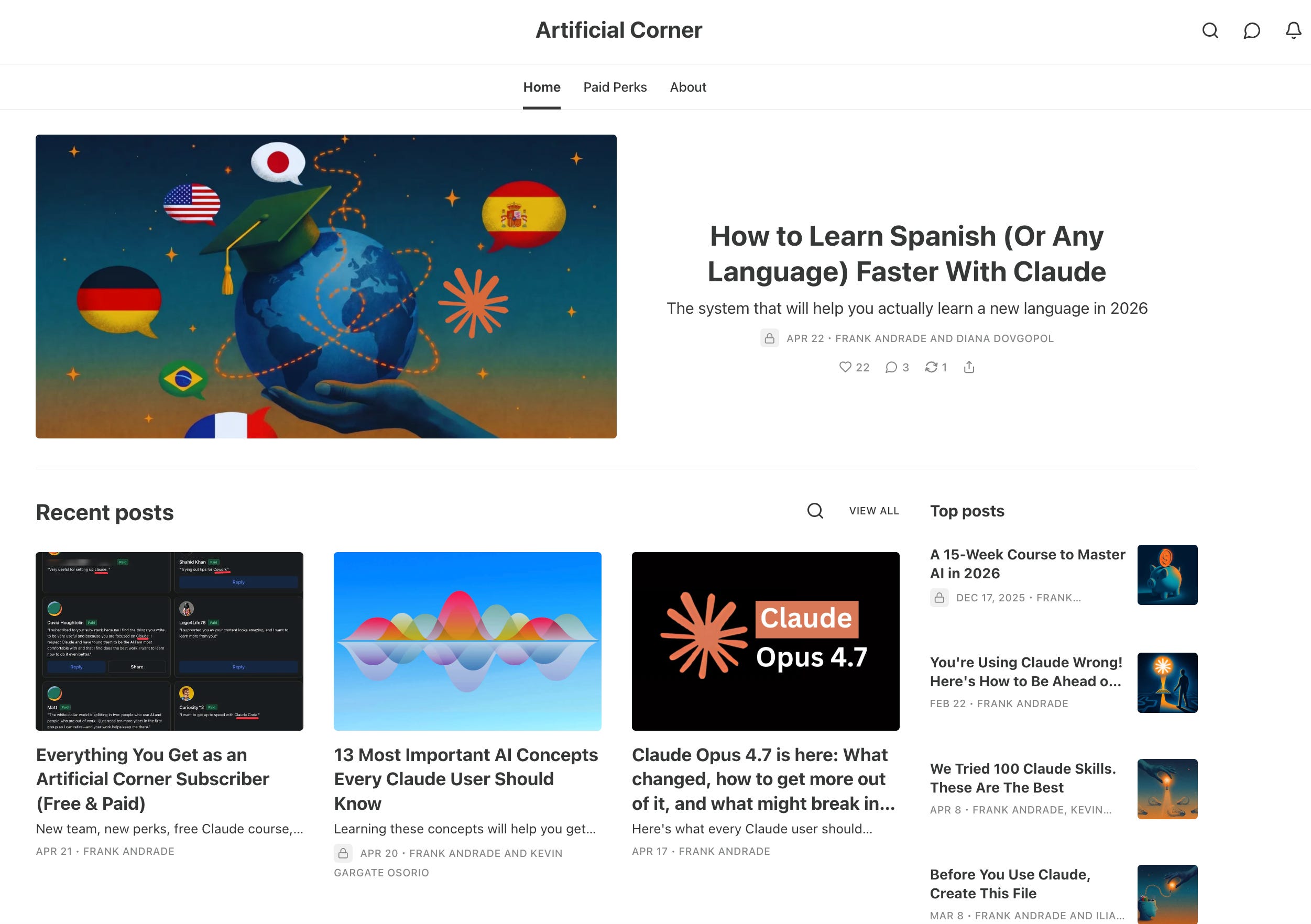
Frank writes about AI.
He picked one tool and went deep.
84% of his Notes mention Claude by name.
What I noticed: Frank uses ✦ ☑ → as bullet glyphs instead of emojis. 21 instances across 45 Notes. Most writers reach for emoji when they want visual variety. Frank reaches for typography. The choice makes his Notes look like a printed handout, not a social post.
The Extraction
87 Note links in the MHTML. After deduplication and filtering to @thepycoach, 45 were Frank’s. The rest were restacks of other writers.
45 is the smallest corpus in this analysis. But Frank is so consistent that 45 is enough. He’s running the same playbook on repeat, and the playbook reveals itself fast.
Frank’s Shape
Average: 2.9 sentences per Note before he transitions into a list.
First-line word count: 6-12 words. Punchy hooks, never longer.
Sentences over 15 words almost don’t exist. He keeps it tight, then opens up into structured lists.
The rhythm is short hook, two-beat reversal, then bulleted payload.
The Two-Beat Reversal
Frank’s signature opening rhythm is a snare-then-kick.
“Most people burn through Claude’s limits by lunch. Not because they use it too much. Because they use it wrong.”
“You don’t need a better prompt. You need the right Claude.”
[wrong assumption]. [actual answer].
Short declarative. Correction. The correction is always shorter than the setup, and it always carries the surprise. He runs this rhythm at the top of his Notes the way Wyndo runs his colon-prompt structure — as a recognizable opener.
The Step Stack
His most repeated structural template:
Hook
“Just follow these steps:”
Step 1: [action]
Step 2: [action]
CTA or link
About 10 of his 45 Notes use this exact structure. The Note reads like documentation. No prose, no stories, no personal asides. Just the steps.
His second template is the prompt library:
“Start with these N prompts:
#1 [Name]
‘[the prompt itself in quotes]’”
The prompts are quoted verbatim, like Wyndo. But Frank wraps them in a numbered list with explicit naming. Wyndo publishes one prompt per Note. Frank publishes 8 in a single post.
“Better Than 99% of People”
A formula Frank uses 3 times in 45 Notes that I haven’t seen anywhere else on this list:
“How to set up Claude better than 99% of people.”
“Set up Claude Cowork better than 99% of people.”
The hook positions the reader as someone about to leapfrog the crowd. It’s a confidence promise. The body of the Note then has to deliver — and Frank delivers with bullet lists of specific settings, prompts, or features.
This is the kind of move most writers avoid because it sounds boastful. Frank uses it because it sounds useful. The difference is whether the Note that follows actually backs the claim. His do.
What He Avoids
Em dashes. 6 across 45 Notes. Mostly in compound phrases, not for drama. Same household rule as everyone else on this list.
No personal life. No family. No location. No politics. No hot takes about other creators.
No corporate language. No “excited to share,” no “humbled,” no “thrilled.”
No hedging. No “I think” or “in my opinion.” He asserts.
No cliffhanger questions. He never closes with “what do you think?” or “agree?”. He closes with a CTA, a link, or a “see more” cliff that the platform inserts after the truncation point.
What He Does That Others Don’t
Frank front-loads. He puts the value above the fold and parks the payoff below “see more.” The reader has to click to expand or click through to artificialcorner.com to get the rest. The Note is the hook. The article is the deliverable.
Most writers on this list treat Notes as the artifact itself. Frank treats them as the door. That distinction shows up in his closings — they’re almost never standalone aphorisms or punchlines. They’re transitions to somewhere else.
He also uses parenthetical asides for stage direction:
“(read them in this order)”
“(free guides included)”
“(link to download all the skills at the end 👇)”
These are small but they work. The asides feel like a teacher leaning in to tell you something extra. They make a list-heavy Note feel personal without him having to write a personal sentence.
DNA Card
WRITER: Frank Andrade
PUBLICATION: Artificial Corner

CORE FORMULA:
Practical Claude educator for non-technical professionals.
Hook with a two-beat reversal, then a structured list,
then a CTA to artificialcorner.com. Notes are the door,
articles are the room.

TOP 3 OPENING PATTERNS:
1. Status drop — "Claude Opus 4.7 just dropped."
2. Diagnosis — "You're using AI wrong."
3. Authority claim — "The best Claude prompt I use is..."

STRUCTURAL TEMPLATES:
1. Step Stack: hook, "Just follow these steps:",
   numbered actions, CTA
2. Prompt Library: hook, "Start with these N prompts:",
   #1 [Name], "[verbatim prompt]"
3. Bullet Showcase: hook, ✦ feature, ✦ feature, link

VOICE MARKERS:
- ✦ ☑ → as bullet glyphs instead of emoji
- "X better than 99% of people" formula
- Year-stamping ("in 2026") for currency
- Parenthetical asides as stage direction
- Numbers everywhere (80%, 99%, $20/month)

WHAT MAKES THIS WRITER DIFFERENT:
Frank treats Notes as the door, not the room. Every
other writer on this list closes with something
self-contained — a maxim, a punchline, a verdict.
Frank closes with a link. The Note's job is to
qualify the click. The article does the teaching.
Try the Artifact
Pick a template. Type a topic. See what comes out.
Then go read Frank’s actual Notes and like&restack the ones you like and compare.
Here is the link to the artifact, trained on Frank’s Notes.
Here’s how it works.
4. Joel Salinas — Leadership in Change

Joel writes for leaders.
His Notes sound like a consultant who stopped billing by the hour and started thinking out loud.
What I noticed: Joel uses the word “leaders” the way most tech writers use “founders.”
It’s his default reader.
Every time he writes “Most leaders...”, he’s signaling who the Note is not for, and that clarity is what makes it land.
The Extraction
79 original Notes after filtering out restacks. Restacks were excluded because they carry someone else’s voice.
What’s left is Joel’s own writing, across strategy, governance, prompting craft, and team enablement.
Joel’s Shape
Median length: 28 words. Shorter than both Wyndo and Ilia.
But the distribution is bimodal. Half his Notes are under 20 words. The other half are 50-90 words. He skips the middle. You’re either getting a micro-insight or a thought-leadership beat. Rarely the in-between.
Average sentence: 8 words. 23% of his sentences are 4 words or fewer.
Triads show up constantly:
“Prompt. Spin. Regenerate. Hope.”
“Emails. Slack. Calendar.”
Three short declaratives stacked, then one longer line that prescribes. That’s the engine.
Diagnose → Prescribe
Joel’s signature structure reads like a doctor’s note. State the problem. Give the evidence. Land the fix.
Example from his corpus:
“Most strategic failures don’t happen because leaders lack intelligence.
They happen because leaders can’t test assumptions fast enough.
The decision window is weeks. The consultant timeline is months.
Twenty minutes of the right AI questions can compress months of expert consultation into something actionable.”
16 of his 79 Notes open with this collective-failure diagnosis. “Most leaders...”, “Most teams...”, “Most strategic...”. He names the failure first, then prescribes.
The “Your X” Stack
When Joel isn’t diagnosing, he’s stacking “Your” declaratives:
“Your team is using AI. Your competitors know it. Your data policies should reflect it.”
Three short sentences, each a fact the reader can’t argue with, ending in a call to act. It reads like a memo that skipped the pleasantries.
What He Avoids
No em dashes. One instance in 79 Notes. That’s a habit, not an accident.
No hype vocabulary. No “game-changer,” no “10x,” no “unlock,” no “supercharge.”
No bullets. No numbered lists. He stacks sentences with line breaks instead.
No hedging. No “I think maybe this might possibly...”
No invented stats. When he gives a number, it comes from his own workflow, not a made-up benchmark.
What He Does That Others Don’t
Joel gives credit generously. He tags collaborators. He praises other writers. He sometimes closes on a soft beat — “:)” or “Love seeing that!” — after a sharp business Note.
This is rare in the AI-tech space. Most writers in the niche perform seriousness. Joel doesn’t perform. He’s serious when the point demands it and warm when the moment allows it.
That mix is part of his DNA.
DNA Card
WRITER: Joel Salinas
PUBLICATION: Leadership in Change

CORE FORMULA:
Diagnose what most leaders do wrong. Give 2-4 beats
of evidence. Land a short prescription the reader
can act on Monday morning.

TOP 3 OPENING PATTERNS:
1. Diagnostic — "Most leaders..." / "Most teams..."
2. "Your" stack — "Your team is using AI."
3. Reader question — "Do you trust AI more for
   research, drafting, or reviewing, and why?"

STRUCTURAL TEMPLATES:
1. Diagnose → Prescribe: failure, evidence, corrective
2. "Your" Stack: three "Your X" sentences, then payoff
3. Reframe → Payoff: common belief, flip, quotable line

VOICE MARKERS:
- "Leaders" as default reader noun
- Triads of short declaratives
- Ellipsis (...) for pause or teaser in ~30% of Notes
- Occasional warm closer after a sharp point

WHAT MAKES THIS WRITER DIFFERENT:
Joel is writing for an audience that most AI writers
ignore — executives and managers, not builders. His
tone reflects it. He sounds like someone who's been
in the boardroom, not someone who's watched a video
about the boardroom.
Try the Artifact
Pick a template. Type a topic. See what comes out.
Then go read Joel’s actual Notes and like&restack the ones you like and compare.
Here is the link to the artifact, trained on Joel’s Notes.
Here’s how it works.
5. Karo — Product with Attitude
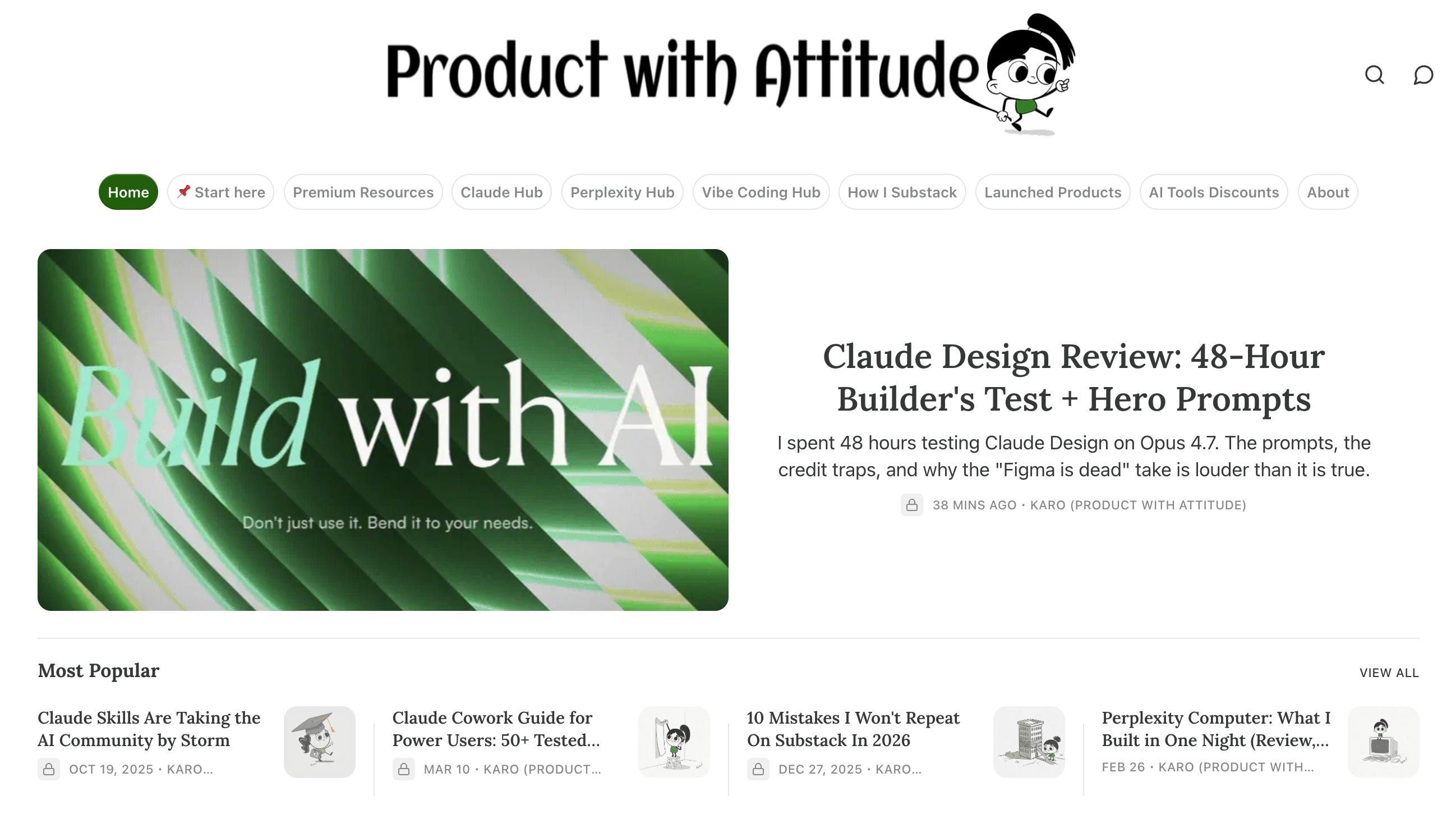
Karo is an AI Product Manager.
Her Notes sound like a senior PM thinking out loud, calm, committed, and uninterested in hype.
What I noticed: Karo writes aphorisms that stand alone. One line. One period. No setup, no payoff, no explanation.
The Extraction
95 Notes by Karo in the HTML.
After separating restacks, link shares, and quote echoes from original thoughts, 56 original-thought Notes remained.
The rest were her amplifying other writers or sharing her own links.
56 is on the smaller side, but her patterns are tight enough that the signal is clean.
Karo’s Shape
Median sentence: 8 words. Same as Joel.
But 36% of her sentences are 6 words or fewer. That’s her rhythm, short stacks, then one shorter line that lands.
She rarely crosses 20 words in a sentence.
When she does, it’s deliberate.
The long sentence sets up a short punchline.
Here’s a real example of the rhythm:
“My ideas don’t arrive in order. They show up all at once. AI has been an incredible thinking partner for me, but only after I learned how to use it for better questions, not faster answers.”
Three short. One long. The long one is where the payoff hides.
The Colon Reveal
23 colons across 56 Notes.
That’s almost one every two Notes. She uses the colon to frame before delivering.
“Before AI: Ideas were easy, building was hard. After AI: Building is easy, choosing the right idea is hard.”
The colon is the switch. The left side sets the frame. Right side flips it.
What She Avoids
No em dashes. 1 instance across 56 Notes. She uses periods where most writers reach for em dashes.
No semicolons. Zero.
No superlatives. No “incredible,” no “insane,” no “mind-blowing.” She could be writing about a genuine breakthrough and still refuse the marketing vocabulary.
No “Here’s what nobody tells you...” framing. No rhetorical self-questioning. No hedges like “I think maybe” or “arguably.”
No redemption arcs. She doesn’t write “I used to do X, then I realized Y.” When she states a position, she just states it.
DNA Card
WRITER: Karo
PUBLICATION: Product with Attitude

CORE FORMULA:
Short, committed declaratives about critical AI
literacy. Aphorisms that stand alone. Colons that
flip. Occasional personal build stories.

TOP 3 OPENING PATTERNS:
1. Cold metaphor — "X is the fast food of Y."
2. Binary frame — "Before AI: ... After AI: ..."
3. Flat negation — "There's no such thing as X."

STRUCTURAL TEMPLATES:
1. Colon Reveal: frame, then payoff — "X: Y."
2. Aphorism-Only: one line, one period, no elaboration
3. Setup-Pivot-Land: 3 short sentences, last hits hardest

VOICE MARKERS:
- Curly quotes, never straight
- 1 emoji maximum per Note (🤗 for warmth, 😂 for
  self-deprecation)
- Commits to views — no hedging
- Names collaborators by full handle when tagging

WHAT MAKES THIS WRITER DIFFERENT:
Karo is the only writer on this list who posts
aphorisms as complete Notes. One line. One period.
No context. The aphorism is the product. Everyone
else wraps their best line in an explanation. She
just posts the line.
Try the Artifact
Pick a template. Type a topic. See what comes out.
Then go read Karo’s actual Notes and like&restack the ones you like and compare.
Here is the link to the artifact, trained on Karo’s Notes.
Here’s how it works.
6. Karen Spinner — Wondering About AI
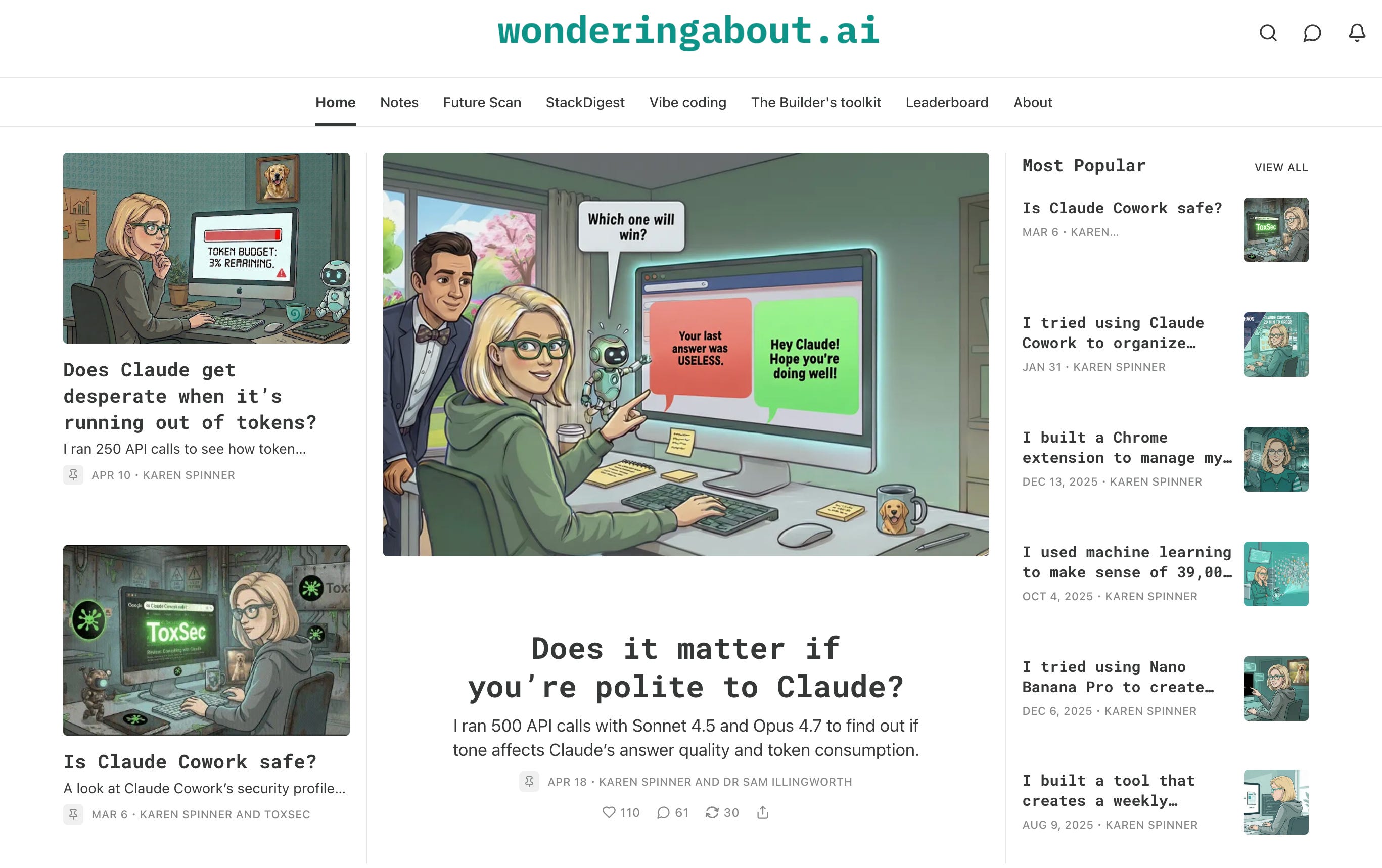
Karen builds a product called CarouselBot.
She writes about what happens while she’s building it.
What I noticed: Karen is the only writer on this list who runs experiments before offering opinions. Most AI writers take a position and find evidence.
Karen takes 500 API calls and lets the result decide what she thinks.
The Extraction
187 feed units in the MHTML.
After separating her own Notes from restacks and article captions, 107 were hers. 35 of those were long-form prose Notes where her real voice lives.
The rest were captions on restacked articles or short endorsements.
35 long Notes is a smaller sample than the others, but Karen’s voice is so consistent that it doesn’t take a big corpus to read her.
Karen’s Shape
Average sentence: 15.6 words. Longer than everyone else so far.
But 20% of her sentences are 5 words or fewer. Those short ones are where the jokes live.
Her rhythm is long → long → short punch. Example from her corpus:
“At one point, Claude told me the code was compiled and ready to test. It wasn’t. 😂”
Two sentences. One sets up. “It wasn’t.” closes it. The 3-word sentence is the whole joke.
The Experiment → Finding → Recommendation
Karen’s signature structure is a lab report compressed into a Note.
Here’s what I ran
Here’s what I found
Here’s what I’m doing differently now
Real example from her corpus:
“Inspired by X research, I ran 250 API calls... Interestingly enough, telling Claude about its constraints produced 100% correctness. Here’s what I’m doing differently now:”
That “Here’s what I’m doing differently now:” is her verbal tic. It shows up across multiple Notes. Other writers would write “So the lesson is...” Karen writes it as an action she already took.
The Bug Story
Her third move is the confession Note. Something broke; here’s what she learned.
“I was exploring Postgres Neon... accidentally clicked the wrong button... which nuked the production database! 🙀 This was a good reminder that sometimes you need MORE friction, not less.”
Most AI writers demonstrate expertise. Karen performs the opposite. She tells you what she broke before she tells you what she figured out. The authority comes from surviving the mistake, not avoiding it.
What She Avoids
No em dashes. 2 in 107 Notes. Same habit as everyone else on this list so far.
No LinkedIn openers. No “Hot take:”, no “Unpopular opinion:”, no “Most people get X wrong.”
No empty superlatives. “Amazing” and “incredible” don’t appear in her writing.
No generic takes. If she has an opinion about a model, it’s attached to a specific version and a specific test. “Opus 4.6 does X.” Not “Claude does X.”
No hustle vocabulary. No “crushing it,” no “shipping hard.” She ships, but she doesn’t brand it.
What She Does That Others Don’t
Karen names names. When she boosts a peer, she uses their full name and what they specifically did. Not “great post from @someone” — “Thanks to Daria Cupareanu for walking through the exact prompt she used to...”
She uses emojis sparingly and tends to use them at the end of a clause. 🤔 for musing. 😂 for self-roasting. 🙀 when something broke badly. The emoji budget is strict.
She trails off mid-sentence with an ellipsis. “So…I’m writing a technical report.” “It’s not a bad design. It’s just…Claude design.” The ellipsis is her hesitation on purpose.
DNA Card
WRITER: Karen Spinner
PUBLICATION: Wondering About AI

CORE FORMULA:
Builder reporting from the lab, not commentator
offering opinions. Every Note is attached to a
specific experiment, a specific bug, or a specific
model version. No abstractions without evidence.

TOP 3 OPENING PATTERNS:
1. First-person experiment — "I ran 250 API calls to..."
2. Declarative + pivot — "Claude Design is powerful. But..."
3. Bug story — "I was exploring X and accidentally..."

STRUCTURAL TEMPLATES:
1. Experiment → Finding → "Here's what I'm doing differently now:"
2. Received wisdom → "But" → counter-evidence → so-what
3. Bug story → what I did → lesson

VOICE MARKERS:
- One emoji per Note, always at end of clause
- Mid-sentence trailing ellipsis (So…I'm thinking)
- Pivots with "But" or "Then" — never "However"
- Full-name credit when boosting peers

WHAT MAKES THIS WRITER DIFFERENT:
Karen is the only writer on this list who runs an
experiment before forming an opinion. Most writers
start with a position and find support. Karen takes
500 API calls and lets the data tell her what the
Note is about. The experiment is the argument.
Try the Artifact
Pick a template. Type a topic. See what comes out.
Then go read Karen’s actual Notes and like&restack the ones you like and compare.
Here is the link to the artifact, trained on Karen’s Notes.
Here’s how it works.
7. Jenny — Build to Launch

Jenny writes about Claude Code, MCP servers, prompts, and what actually works when you’re building something real.
What I noticed: Jenny is the only writer on this list who uses em dashes on purpose. Every other writer avoids them. Jenny uses 89 across 105 Notes. That’s not an accident. It’s a stylistic choice she’s committed to.
The Extraction
131 Note bodies in the MHTML. After filtering by author permalink, 112 were Jenny’s. After dedup, 105 unique Notes.
The decoding had a quirk, quoted-printable encoding mangled the emojis on the first pass. Turns out there weren’t any.
Jenny doesn’t use emojis in her teaching Notes. That “mangled emoji” was just a tree character (↳) she uses as a list marker.
Jenny’s Shape
Average length: 54 words. Hard-capped under 100. The ceiling is deliberate.
Modal structure: 4 paragraphs.
Median sentence: 7 words. 37% of her sentences are 5 words or fewer.
Her rhythm is long → short → short. A statement, then two fragments that land. You can feel her picking a complete sentence, then deciding the last two beats don’t need one.
The “I + Past Tense + Number” Opener
34% of Jenny’s Notes open with her doing something specific, with a number attached.
“I installed 11 plugins...”
“I tested this with 40 prompts...”
“I killed my bookmarks folder...”
“I kept 3 out of 18 cron jobs...”
The number does the work. It signals this isn’t advice. It’s a report.
Another 19% open with a quantifier, “Every,” “Most,” “Everyone,” or a count. Her openings are built on specificity.
She almost never opens with a question. The one thing she doesn’t do is ask you something to get you engaged.
The “Most People X. But These N Moves” Structure
Her signature teaching structure looks like this:
Most people do X wrong
These N specific moves fixed it for me
Each move is one em-dash bolded label plus one sentence
Optional follow-up line with ↳ as the marker
It reads like documentation written by someone who’s tired of answering the same question in DMs.
The Em Dash Habit
Here’s what separates Jenny from everyone else in this analysis.
Wyndo: 8 em dashes across 172 Notes. Ilia: 10 across 71. Joel: 1 across 79. Karo: 1 across 56. Karen: 2 across 107.
Jenny: 89 across 105.
That’s almost one per Note. Em dashes are her primary device for mid-sentence pivots. Where Ilia uses a period, Jenny uses an em dash. Where Karo uses a colon, Jenny uses an em dash.
If you’re copying Jenny’s voice, the em dashes are not optional.
Closings That Reframe
Jenny doesn’t summarize at the end. She reframes.
“It’s a clarity problem.”
“The old prompt got agreement. The new one gets a bug report.”
“The test at the end isn’t extra. It’s the whole point.”
The closing line recontextualizes everything above it. A Note that sounded like a list of tactics suddenly becomes a Note about one principle. The last sentence is where she earns the read.
What She Avoids
No emojis in teaching Notes. Zero.
No exclamation marks. Her tone stays flat when she’s teaching.
No hype vocabulary. No “game-changer,” “leverage,” “unlock,” “secret,” or “hack.” Not once in 105 Notes.
No ALL CAPS. No “guys” or “folks” as audience address.
No hashtags. No DM asks.
DNA Card
WRITER: Jenny Ouyang
PUBLICATION: Build to Launch

CORE FORMULA:
Senior-engineer log entries. Every teaching Note is
anchored in a specific number she ran herself.
Hard-capped under 100 words, typically 4 paragraphs,
with em dashes doing the pivots.

TOP 3 OPENING PATTERNS:
1. "I + past tense + specific number"
   — "I installed 11 plugins..."
2. Quantifier lead — "Every," "Most," "Everyone"
3. Thing-that-worked — "The thing that made AI
   actually useful for Y..."

STRUCTURAL TEMPLATES:
1. "Most people X. But these N moves..." with em-dash
   bolded labels and ↳ follow-ups
2. "I had X, Y, Z. Then I stopped." confession structure
3. Aphorism-to-evidence: short claim, then the numbers
   that justify it

VOICE MARKERS:
- Em dashes as primary mid-sentence pivot (89 in 105)
- ↳ tree character for list follow-ups
- Specific numbers in almost every teaching Note
- Closings that reframe, not summarize

WHAT MAKES THIS WRITER DIFFERENT:
Jenny runs the experiment and keeps the receipt.
Her Notes read like a log book, not a blog. The
numbers she cites — 11 plugins kept 3, 18 cron
jobs, 40 bookmarks — make the teaching credible
in a way opinion-based Notes can't touch.
Try the Artifact
Pick a template. Type a topic. See what comes out.
Then go read Jenny’s actual Notes and like&restack the ones you like and compare.
Here is the link to the artifact, trained on Jenny’s Notes.
Here is what it looks like.
8. Daria — AI Blew My Mind
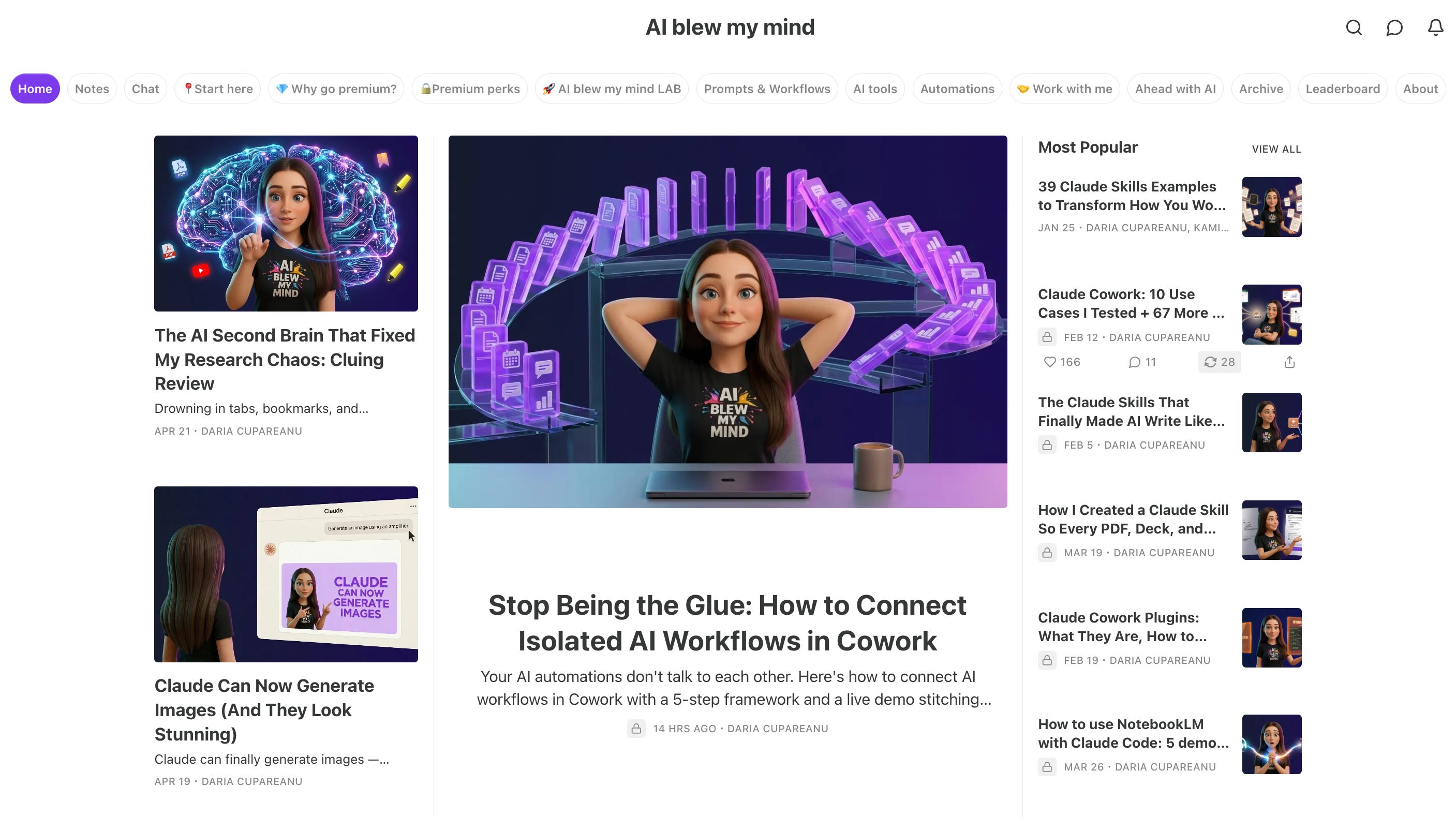
Daria writes about Claude the way someone writes about a tool they actually use every day.
Her publication name is a promise. AI Blew My Mind. And 16 times across her corpus, she says exactly that phrase.
What I noticed: Daria drops one-line punchlines after 2-3 setup paragraphs, and the punchline is almost always under 10 words. “Just move.” “This is why I do what I do.” The setup builds weight. The punchline releases it in one breath.
The Extraction
189 feed items in the MHTML. After filtering 29 restacks and 4 post-share cards, 156 original Notes remained. Total corpus: 7,735 words.
The top 30 by likes were saved separately. Those are the Notes where her voice lands hardest.
Daria’s Shape
Median sentence: 7 words. Same as Joel. Same as Ilia.
But here’s what separates her: 18% of her sentences are 3 words or fewer. That’s extreme. Even Ilia at 32% fragments doesn’t push this short.
Fragments are her rhythm reset. Long sentence. Shorter sentence. Fragment. Long sentence again.
46% of her paragraphs are single-sentence. Almost half of everything she writes is one sentence standing alone on its own line.
The Setup → Punchline
Daria’s signature structure is 2-3 paragraphs of setup, then a one-line closer under 10 words.
33% of her Notes end this way. It’s the most consistent structural signal in her corpus.
The setup does the argument. The punchline does the release.
[setup]
Just move.
[setup]
This is why I do what I do.
The punchline is always shorter than any sentence in the setup. That contrast is what makes it land.
“Not X. But Y.”
Her second signature move is the negation flip, but with a twist. Where Ilia uses “X isn’t Y. It’s Z.” Daria uses “X isn’t Y. But Y.” — making the “but” do the pivot work.
“AI isn’t built to know things. It’s built to relate things to each other.”
Same mechanical shape as Ilia. Different cadence. Ilia’s version feels like a verdict. Daria’s feels like a realization.
Anaphora
15% of her Notes use anaphora — the same 2-word opener repeated across consecutive sentences.
“That’s why it gets the big picture right.
That’s why it can give you a solid business plan outline...”
“That’s why” is her favorite causal bridge. She uses it to stack evidence without ever having to say “furthermore” or “additionally.” The rhythm does the connecting.
What She Avoids
No em dashes. 5 across 7,735 words. Consistent with the pattern across this list.
No semicolons. Zero.
No hype vocabulary. “Amazing,” “incredible,” “revolutionary,” “game-changing” don’t appear once.
No thread formatting. No “1/”, no “🧵”, no “a thread:”.
No meta-openers. No “Let me tell you...” No “In this post...”
No hedging. “Maybe,” “perhaps,” “I think” are rare.
What She Does That Others Don’t
Daria drops real quotes. 24% of her Notes contain dialogue — from readers, clients, her mom, or herself. The quote is the evidence.
“AI just blew my mom’s mind.” That’s a full Note opener.
Other writers paraphrase what people say to them. Daria just puts it in double quotes.
She also writes to “you” more than to “leaders” (Joel) or “I” (Wyndo). Second-person is 18% of her openings. She addresses the reader directly and often — “You don’t figure out AI and then start using it.”
DNA Card
WRITER: Daria Cupareanu
PUBLICATION: AI Blew My Mind

CORE FORMULA:
Practitioner reporting, not pundit speculation. Every
Note comes from the chair she sits in when she ships.
Setup in paragraphs, release in a one-line punchline.

TOP 3 OPENING PATTERNS:
1. Declarative fact — "AI isn't built to know things."
2. Second-person directive — "You don't figure out AI
   and then start using it."
3. Contrarian setup — "Everyone wants to keep up with AI."

STRUCTURAL TEMPLATES:
1. Setup → Punchline: 2-3 paragraphs, one-line close
   under 10 words
2. Not X. But Y.: negation flip with "but" pivot
3. Anaphora: "That's why..." repeated across 2-3
   consecutive sentences

VOICE MARKERS:
- 18% of sentences are 3 words or fewer
- 46% of paragraphs are single-sentence
- Double quotes for dialogue or sarcastic framing
- "That's why..." as the causal bridge
- One emoji max, used sparingly (🥲 😄 🤭)

WHAT MAKES THIS WRITER DIFFERENT:
Daria is the only writer on this list who quotes
the people around her. Her mom. Her clients. Her
readers. 24% of her Notes contain real dialogue in
double quotes. Everyone else paraphrases. She just
copies the line and puts it on the page.
Try the Artifact
Pick a template. Type a topic. See what comes out.
Then go read Daria’s actual Notes and like&restack the ones you like, and compare.
Here is the link to the artifact, trained on Daria’s Notes.
Here is what it looks like.
9. Sam Illingworth — Slow AI
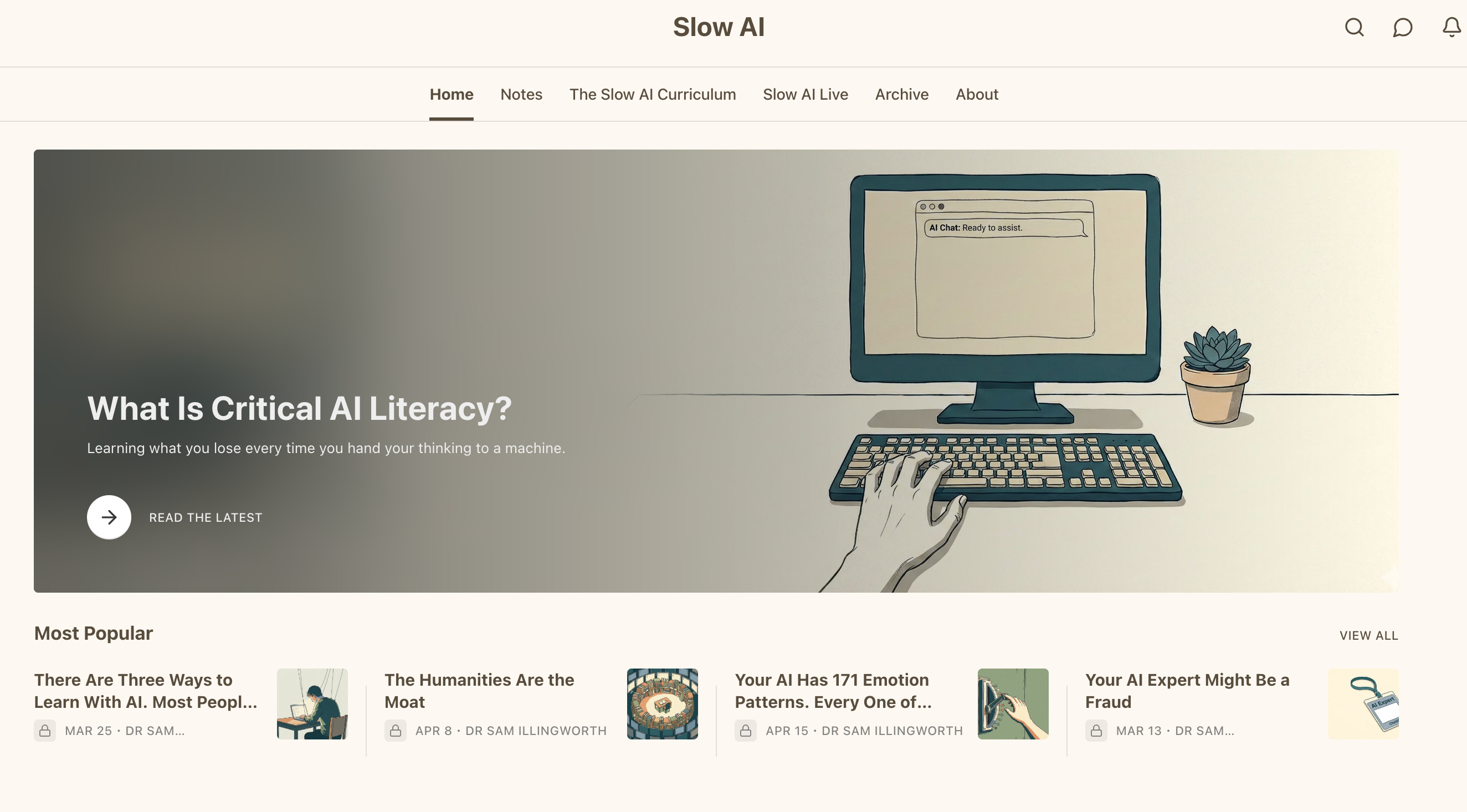
Sam is a professor and poet in Edinburgh. He writes about AI the way a good political journalist writes about power.
What I noticed: Sam is the only writer on this list whose subject isn’t AI craft. It’s AI power. Who builds it, who pays for it, who stays invisible in the coverage. Every Note is a press briefing with the press release removed.
The Extraction
117 unique Notes after deduplication. Average 231 words, median 71. The distribution is bimodal — short announcements and shoutouts on one side, longer commentary on the other.
The voice lives in the commentary half. The announcements are functional. The shoutouts follow a template he reuses almost word-for-word. What’s distinct is everything in between.
Sam’s Openings
Four moves, in order of frequency.
Statistic-as-sentence (37%). A hard number, planted as a standalone declaration.
“Grok 4’s training emissions reached 72,816 tonnes of CO2 equivalent.”
“Three in four US teens have already used an AI companion.”
Named actor + action + date (30%). A specific company, official, or institution doing a specific thing on a specific date.
“Mike Krieger sat on Figma’s board while Anthropic built a Figma rival.”
“Coventry City Council just renewed its Palantir contract for £750,000.”
Reframing aphorism (20%). A sentence that looks like a claim but is actually a trap being set.
“The company that built tools to watch everyone else is now watching its own staff.”
“When respected artists adopt AI, we call it evolution. When students do, we call it cheating.”
Imperative or question (13%). “Stop being polite to AI.” “Who owns the language of AI?”
None of these hedge. No “I think,” no “perhaps.” Cold open, every time.
Fact / Turn / Verdict
Sam’s signature structure is a three-beat move.
Open with a cold fact
Introduce the overlooked second fact that reframes the first
Close with a one-line verdict that names the mechanism, not the emotion
The Anthropic pricing Note is the clearest example:
“Anthropic announced last week that Claude Opus 4.7 costs the same per token as its predecessor.
They did not mention that the new tokenizer uses up to 35% more tokens to process the same input.
The per-token price is unchanged. Your bill is not.”
Three beats. The verdict isn’t an opinion. It’s the frame being named. “Per-token price is unchanged. Your bill is not.” That’s how a journalist closes a story when the story is really about how stories are told.
Clipped Parallelism
Sam’s rhythmic fingerprint is parallel short sentences, usually in threes.
“Not a forecast. Not a white paper. Not a press release.”
“No regulator. No court. No parliament.”
“Nobody to call. Nobody to fire.”
“The public pays for the infrastructure. The compute leaves the country. The reactors stay for decades.”
When he wants the reader to feel a pattern, he makes them hear it. Three identical structures. Each one shorter than a tweet. The rhythm carries the argument.
Naming the Frame
Here’s the move that separates Sam from every other writer on this list. He doesn’t just report what the coverage says. He describes how coverage works.
“The spending is reported as investment. The consequences are reported as externalities.”
“This is what a pricing-unchanged headline looks like when one number stays fixed and the other quietly moves.”
Most AI writers argue with the conclusions in industry headlines. Sam argues with the sentence structure. He’s writing about how the language itself hides the thing that matters.
What He Avoids
No em dashes. 2 across 117 Notes.
No emojis, except occasional 🚨 for corrections.
No exclamation marks in commentary Notes.
No hedging. “I think,” “in my opinion,” “personally” don’t appear. The evidence carries the claim.
No hype vocabulary. “Game-changer,” “revolutionary,” “insane” appear once across the corpus, and that instance is quoting someone else.
No listicles, no “1/” threads, no hook-then-thread formatting.
No speculation without a source. Every assertion comes with a name, a date, or a citation baked into the sentence.
What He Does That Others Don’t
Sam names people. Not “a Big Tech CEO” — Alex Karp, Mike Krieger, Rachael Maskell. Not “a study” — “Stanford’s 2026 AI Index,” “Common Sense Media’s risk assessment.” Names make the Note unignorable.
He uses British spelling. Behavioural. Summarise. Labour. Centre. Dates as “16 April,” not “April 16th.” Currency with the symbol up front: £330m, not “330 million pounds.”
He uses single quotes to scare-quote the industry’s own words. ‘Research preview.’ ‘Scalable oversight.’ ‘AI redundancy washing.’ The quotes say this is what they’re calling it, not what it is.
DNA Card
WRITER: Sam Illingworth
PUBLICATION: Slow AI

CORE FORMULA:
Journalist covering AI power, not AI craft. Every
commentary Note is built on named actors, specific
dates, and hard numbers. The verdict names the
frame, not the feeling.

TOP 3 OPENING PATTERNS:
1. Cold statistic — "72,816 tonnes of CO2 equivalent."
2. Named actor + action + date — "Coventry Council
   renewed its Palantir contract for £750,000."
3. Reframing aphorism — "The company that built tools
   to watch everyone is now watching its own staff."

STRUCTURAL TEMPLATES:
1. Fact / Turn / Verdict: cold fact, overlooked
   second fact, one-line mechanism-naming close
2. Stat / Mechanism / Moral cost: headline number,
   how it works, cost the coverage hid
3. Category swap: "When X does it we call it A.
   When Y does it we call it B. Same tool, different
   permission structure."

VOICE MARKERS:
- Clipped parallelism in threes
- British spelling and date format
- Single quotes for the industry's own words
- Sources named in-sentence, not appended

WHAT MAKES THIS WRITER DIFFERENT:
Sam doesn't argue with what industry coverage says.
He argues with how it says it. The subject of most
Notes is the sentence structure of the press release,
not the product in the press release. No other writer
on this list works this register.
Try the Artifact
Pick a template. Type a topic. See what comes out.
Then go read Sam’s actual Notes and like&restack the ones you like and compare.
Here is the link to the artifact, trained on Sam’s Notes.
Here’s what it looks like.
10. Yevheniya — Mother Using AI
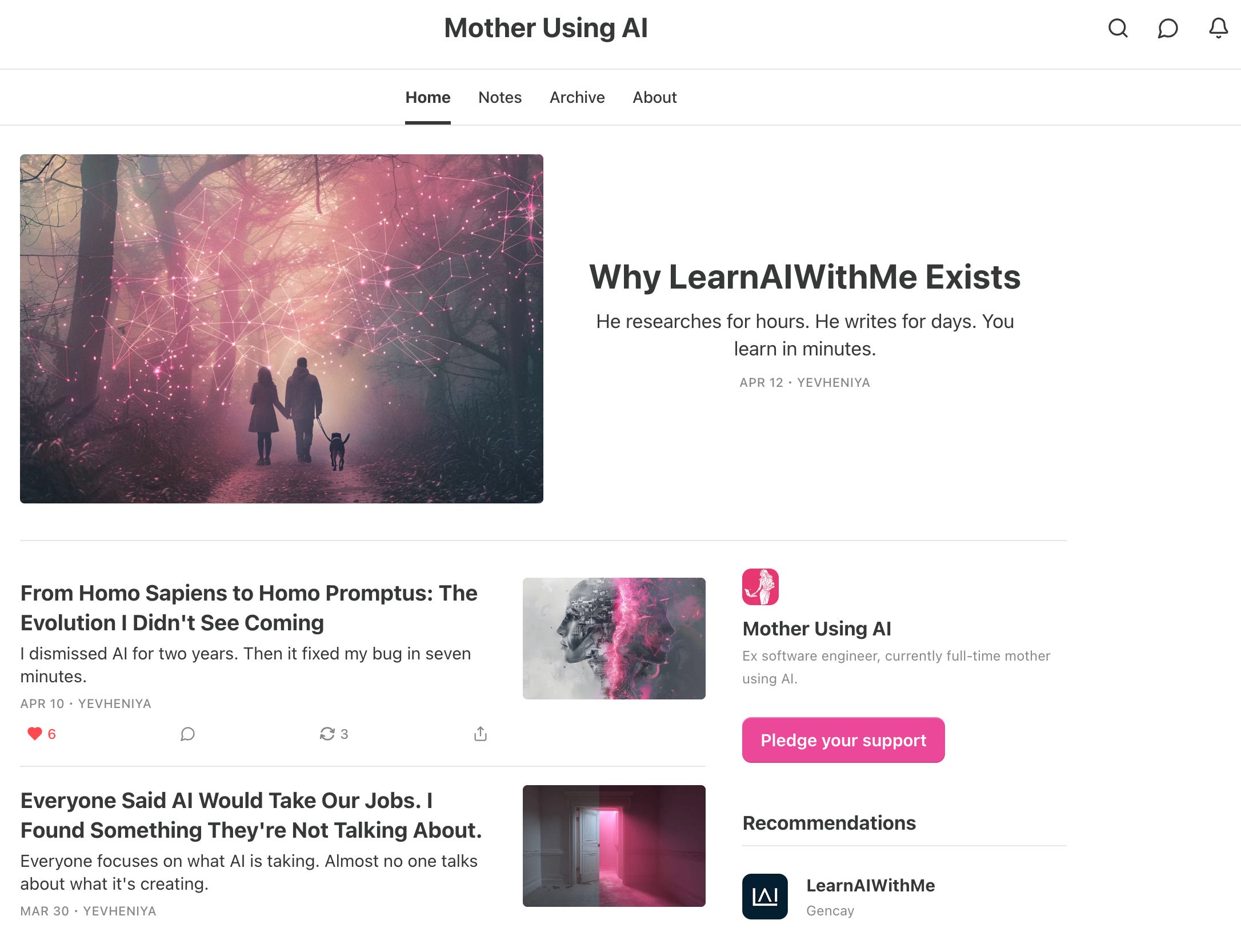
Full disclosure: Yevheniya is my wife and the co-founder of Learn With Me AI. I ran her Notes through the same process as everyone else on this list.
The DNA card came back with patterns I didn’t fully see, even after reading her Notes for a year.
What I noticed: Yevheniya opens Notes with “AI won’t,” “AI didn’t,” or “AI doesn’t” 16 times across 99 Notes. That’s 16%. She sets up a fear or expectation about AI, then the second sentence reverses it. The reversal is her entire formula.
The Extraction
174 Note links in the MHTML. After deduplication, 106 unique Notes. 99 were originals. 7 were restacks of my own Notes, which I filtered out.
Median length: 25 words. Shorter than any other writer on this list.
Yevheniya’s Shape
Median sentence: 6 words. 48% of her sentences are 5 words or fewer.
Her rhythm is short-short-short-longer-short. Sometimes short-shorter-shortest. Fragments are fair game.
Examples from her corpus:
“3 hours a week back.”
“Automatically.”
“On repeat.”
“Different question. Different life.”
These aren’t decorative. They’re landings. A two-word sentence on its own line is where the Note earns its keep.
The Reversal
Her signature structure is the AI-reversal. 16 Notes open with it.
Sentence 1: “AI won’t / didn’t / doesn’t [feared outcome].” Sentence 2: “It [unexpected outcome].”
Real example:
“AI didn’t give me more time. It took away my favorite excuse.”
The reversal lives entirely in sentence 2. “It” does the work. 8 of her 16 reversal openings pivot with “It” as the subject of the second sentence.
This is the tightest structural signal I saw in any of the 9 writers analyzed so far. Nobody else runs a two-sentence setup-flip this often.
The Husband Story
8+ Notes open with “My husband [past-tense verb]...” Her second signature.
“My husband said ‘I’ll build a machine that writes SEO articles while I sleep.’ I said good luck with that. Now it scrapes Google, finds keyword gaps, and writes articles.”
Three beats. Claim. Skeptical narrator. Punchline.
She is always the skeptic. The husband is always the protagonist-builder. This frame lets her write about AI builds from the outside, which is a rare voice in the AI-tools niche. Most writers who publish builds are the builders. She’s the one watching someone build and asking whether it actually works.
Naked Numbers
Yevheniya uses numbers as punchlines. No setup. No “approximately.” No “around.”
“56% more.” “3 hours a week back.” “150K+ stars in 4 days.” “2,000 developers.” “$2,000 project.”
The number arrives on its own line or at the end of a sentence, stripped of hedges. The specificity makes the claim unarguable.
What She Avoids
No em dashes. Zero across 99 Notes.
No exclamation marks in AI-tools Notes. The 4 exclamations in her corpus all come from the earlier pregnancy cluster, where her voice was warmer.
No emojis in the AI-tools Notes. They show up in pregnancy Notes. Different context, different rules.
No hedging. “Maybe,” “I think,” “kind of” don’t appear in her declarations.
No rhetorical questions at the open. Questions show up later in a Note, if at all.
No corporate jargon. No “leverage,” “synergy,” or “democratize.”
What She Does That Others Don’t
Yevheniya is the only writer on this list who uses a recurring character other than herself. “My husband” shows up in 8+ Notes as a protagonist she narrates around.
This solves a problem that most AI-tools writers run into. When every Note is “I did X,” the voice gets self-centered fast. When some Notes are “someone close to me did X and I watched it work,” the voice becomes observational. Same topic, different chair.
She also uses “you” differently from the others. “You” doesn’t appear at the top of her Notes. It shows up mid-way, only to land the lesson. The Note is about her, or about me, or about a news beat — and then “you” arrives at the end to take the takeaway home.
DNA Card
WRITER: Yevheniya
PUBLICATION: Mother Using AI

CORE FORMULA:
Short, declarative reversals. Sentence 1 sets up a
fear or expectation. Sentence 2 flips it. Numbers
arrive naked. Fragments land the verdict.

TOP 3 OPENING PATTERNS:
1. AI won't / didn't / doesn't + reversal in sentence 2
2. "My husband + past-tense verb" — the husband story
3. "Most people X. I Y." — differentiation opener

STRUCTURAL TEMPLATES:
1. The Reversal: feared outcome, then "It [unexpected]"
2. Husband Story: claim, skeptical narrator, punchline
3. Before / After: "I used to X. Now Y."

VOICE MARKERS:
- 48% of sentences are 5 words or fewer
- "It" as pivot subject in sentence 2
- Numbers arrive naked — no "approximately"
- Parallel couplets as closers ("The tool is free.
  The X isn't.")

WHAT MAKES THIS WRITER DIFFERENT:
Yevheniya is the only writer on this list who writes
from the narrator's chair, not the builder's. Her
husband is the protagonist-builder in 8+ Notes. She
is the skeptic watching, then reporting what actually
worked. No other writer in the AI-tools niche uses
this observational frame.
Try the Artifact
Pick a template. Type a topic. See what comes out.
Then go read Yevheniya’s actual Notes and like&restack the ones you like and compare.
Here is the link to the artifact, trained on Yevheniya’s Notes.
Here’s what it looks like.
11. Gencay — LearnAIWithMe
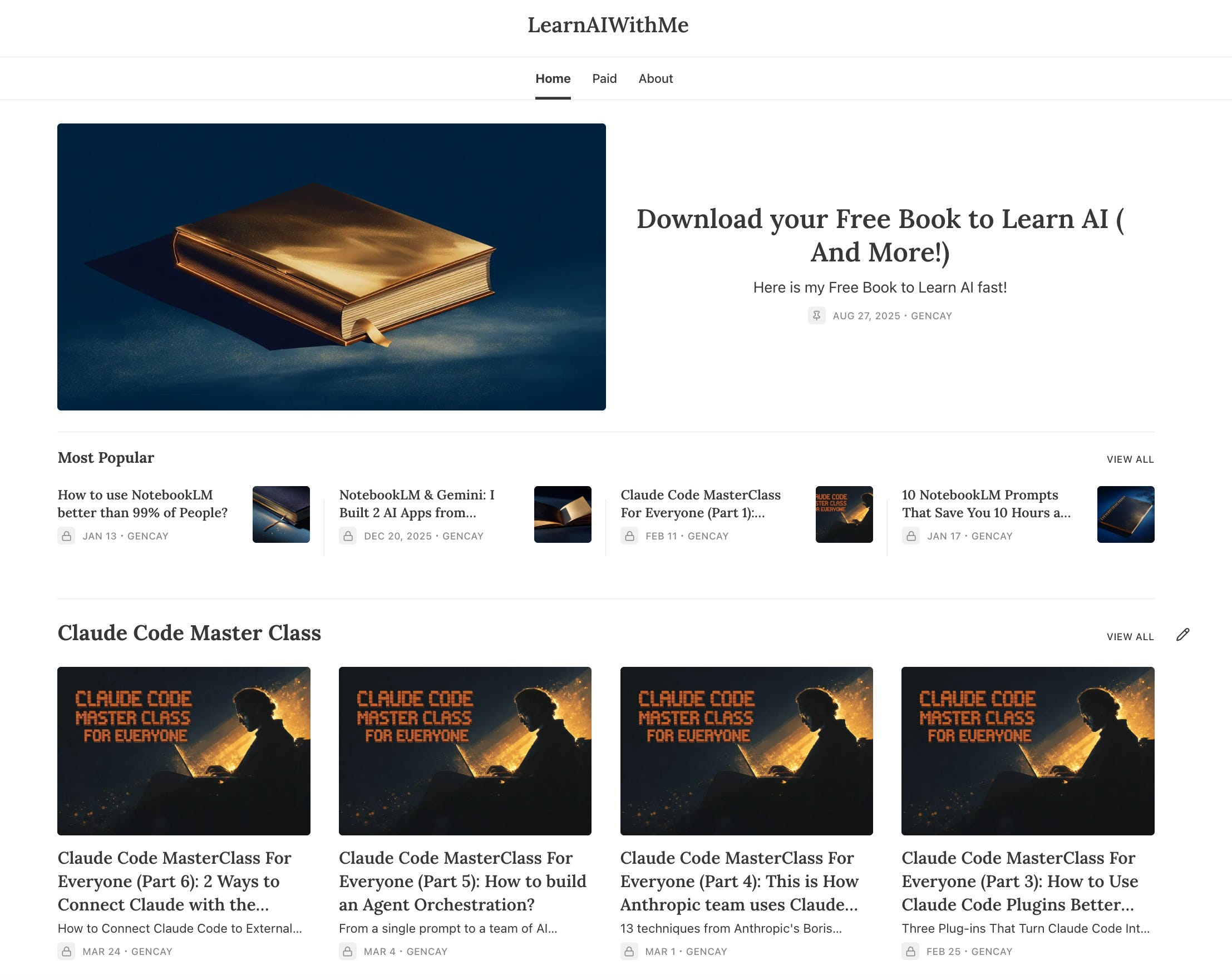
The narrator goes last.
I ran the same prompt on my own Notes. If the Claude Artifact at the end of this section produced notes my wife couldn’t tell apart from mine, the method works.
What I noticed: I open Notes with obituaries more often than I realized. “R.I.P [X]. R.I.P [Y]. R.I.P [Z].” 12 times across 148 Notes. I didn’t know I was doing this on repeat. The DNA card showed me a pattern I’d been using without naming.
The Extraction
148 unique Notes pulled from the MHTML. Median length: 34 words. 4 short paragraphs per Note is the modal shape. One sentence per paragraph, blank line between.
My Shape
Median sentence: 6 words. Same range as Daria, Joel, and Ilia.
But my structural signature isn’t sentence rhythm. It’s paragraph rhythm. Every Note is a stack of 3-5 one-line paragraphs separated by blank lines. No flowing prose. No conjunction-chained sentences. The line break is the pause.
The Obituary
The single most repeated structure in my corpus. 12 Notes open this way.
“R.I.P Canva. R.I.P Figma. R.I.P Adobe.
Claude just killed the $10B design tool industry.”
Three parallel R.I.P. lines, then the verdict, then the mechanic, then usually a “MEGA PROMPT:” payload or an arrow CTA. It’s the obituary-as-hook, and it runs on outrage math — if three specific tools just died, you want to know what killed them.
The Stop Command
20 Notes open with “Stop [doing common thing].”
“Stop paying for AI courses.” “Stop using ChatGPT for research.” “Stop writing prompts from scratch.”
The command is the reversal in one sentence. No setup. The next line explains the cost of the behavior. The line after gives the replacement.
The Most-People Reveal
12 Notes open with “Most people [do the basic thing]. The 1% [do the advanced thing]. I [did the crazy thing] in [N minutes].”
It’s a three-tier ladder. Crowd at the bottom. Experts in the middle. Me at the top, with a specific time claim. Then a payload link.
I noticed something when I saw this pattern laid out. I’m using time claims constantly. “In 8 minutes.” “In 30 seconds.” “In one prompt.” That’s the proof language. Specific time beats vague promise.
The Arrow
77 Notes end with “→” as the CTA terminator. More than half.
Nobody else in this analysis uses arrows this heavily. Wyndo uses maxims. Ilia uses aphorisms. Karo uses periods. I use arrows. The arrow points the reader toward the thing I want them to do next — usually a subscribe prompt, a link, or a “save this” line.
Whether the arrow still works after this much repetition is a separate question. The data says I trust it.
What I Avoid
No em dashes. 3 across 148 Notes. Same household rule as Yevheniya — we share a house style.
No hedging. “Maybe,” “I think,” “kind of” don’t appear in my declarations.
No questions as openers. 4 out of 148 Notes end in a question. Opening questions are rarer.
No philosophy without a payload.
Every Note ships something — a prompt, a link, a tool, a build. The DNA card calls this out explicitly, and looking at the corpus, it’s true.
What the Self-Analysis Told Me
Two things I didn’t know about my own Notes before running this.
One: I use dollar figures as industry markers constantly. “$10B industry.” “$60B industry.” “$150B industry.” The number does the framing. Without the dollar figure, “Claude just killed X” lands softer. With it, the stakes feel real.
Two: I credit strangers. 5 Notes open with “Someone just [verb]...” where the someone is a builder I don’t know personally.
I was doing this without thinking of it as a pattern. The DNA card named it.
DNA Card
WRITER: Gencay
PUBLICATION: Learn With Me AI

CORE FORMULA:
One idea per line. Obituary, stop command, or news hit
at the top. Specific dollar figure or time claim in the
middle. Arrow, colon-setup, or 6-word punch at the end.

TOP 3 OPENING PATTERNS:
1. Obituary — "R.I.P [X]. R.I.P [Y]. R.I.P [Z]."
2. Stop command — "Stop paying for AI courses."
3. Most-people reveal — "Most people X. 1% Y. I Z."

STRUCTURAL TEMPLATES:
1. Obituary → mechanic → MEGA PROMPT payload
2. Stop / Start: command, cost of behavior, replacement
3. News hit → consequence → arrow CTA

VOICE MARKERS:
- One sentence per paragraph, blank line between
- Arrow (→) as CTA terminator in 77 of 148 Notes
- Specific dollar figures for industry size
- Time claims with exact numbers ("in 8 minutes")
- Credit-the-stranger opener ("Someone just...")

WHAT MAKES THIS WRITER DIFFERENT:
Paragraph rhythm over sentence rhythm. Most writers on
this list earn their voice through sentence cadence.
Mine is built on whitespace. A Note is a stack of
one-line beats with blank lines between, and the
rhythm comes from the breath the break forces.
Try the Artifact
Pick a template. Type a topic. See what comes out.
Then go read Gencay’s actual Notes and like&restack the ones you like and compare.
Here is the link to the artifact, trained on Gencays Notes.
Here’s what it looks like.
What They All Share
Eleven writers. Eleven different DNAs. But when I laid the cards side by side, four patterns showed up across all of them.
1. Nobody Uses Em Dashes
Except Jenny.
Count across the corpus:
Wyndo: 8 in 172 Notes
Ilia: 10 in 71
Frank: 6 in 45
Joel: 1 in 79
Karo: 1 in 56
Karen: 2 in 107
Sam: 2 in 117
Daria: 5 in 156
Yevheniya: 0 in 99
Gencay: 3 in 148
Jenny: 89 in 105
Ten of eleven writers have effectively banned the em dash from their Notes. Jenny runs almost one per Note.
This isn’t a coincidence. Em dashes are one of the most reliable tells that a piece of writing was touched by an LLM. Every writer on this list who wants their Notes to read as unmistakably human has quietly decided to stop using them.
Periods do the same work. Colons do better. The em dash is the first thing to go.
If you’re copying any of these voices, this is the non-negotiable rule. The punctuation you avoid matters more than the punctuation you use.
2. They All Run Formulas
Every writer on this list has a small library of structural templates they run on repeat.
Wyndo: 5-line skeleton, used in 37% of Notes
Ilia: Negation pivot, used in 35%
Frank: Two-beat reversal opener, used across most Notes
Joel: Diagnose → Prescribe, used in 20%
Daria: Setup → Punchline, used in 33%
Karen: Experiment → Finding → “Here’s what I’m doing differently now”
Sam: Fact / Turn / Verdict
Yevheniya: The Reversal, used in 16%
Gencay: Obituary, used in 8%
The templates are different. But the fact of having templates is universal. Nobody on this list writes every Note from scratch. They’ve found 3-5 shapes that work, and they run them.
This is the least glamorous finding in this entire analysis. It also might be the most useful.
If you’re trying to build a voice on Notes, you don’t need a new idea for every post. You need three or four structures you can pour new topics into. The template is the infrastructure. The topic is the content.
3. Their Signatures Are in the Small Details
Every writer’s “what makes them different” line came down to something small.
Wyndo: Prompts in straight quotes, not curly
Ilia: Closing couplets that compound
Frank: ✦ ☑ → as bullet glyphs instead of emoji
Karo: Posting aphorisms as whole Notes
Karen: One emoji per Note, always at end of clause
Jenny: The ↳ tree character for list follow-ups
Sam: Single quotes to scare-quote industry language
Daria: Real dialogue from her mom in double quotes
Yevheniya: “It” as pivot subject in sentence 2
Gencay: The arrow (→) as CTA terminator
None of these sound like much on their own. A punctuation choice. A specific character. A quoting convention.
But these are the fingerprints. If you take Ilia’s negation pivot and use it without the compounding couplet close, you get the structure without the signature. The big moves are learnable. The small details are what make a copy feel like a copy instead of the real thing.
When I write in Wyndo’s voice, I have to remember the straight quotes. When I write in Sam’s voice, I have to remember British spelling. These aren’t stylistic preferences. They’re the difference between sounding like someone and being them.
4. They All Stay in a Lane
Not one writer on this list writes about everything.
Wyndo: Prompts and thinking with AI
Ilia: Claude, Cowork, Dispatch, context engineering
Frank: Claude features, prompts, Anthropic news
Joel: Leadership, governance, AI adoption strategy
Karo: Critical AI literacy, building in public
Karen: Her product CarouselBot, model behavior, API gotchas
Jenny: Claude Code, MCP, builder craft
Sam: AI power, regulation, Big Tech accountability
Daria: Claude workflows, “AI blew my mind” reactions
Yevheniya: Practical AI tools, freelance/time/money axis
Gencay: Claude Code, NotebookLM, agents, builds
None of them are “AI generalists.” Every writer occupies a specific territory, and everything outside that territory goes into their articles or gets skipped entirely.
This is the part most new Substack writers get wrong. They post Notes about AI strategy, then prompts, then news, then a personal anecdote, then a prediction about 2027. The result is a feed that reads like a newsletter with no beat.
Every writer on this list chose a beat. They stayed on it. Their Notes got recognizable.
What This Means If You’re Writing Notes
Two things, in order of importance.
One: Find your three formulas. Pick someone on this list whose voice you respect. Copy their structural templates for a month. You won’t end up writing like them. You’ll end up finding which shapes work in your own voice, and the repetition builds the muscle.
Two: Pick a lane and stay in it for 90 days. The writers on this list didn’t get recognized for being interesting across every topic. They got recognized by being reliable on one.
The Last Thing
I built eleven Claude Artifacts for this article. One per writer. You can try any of them.
But the Claude Artifacts aren’t the point. The point is that once you see the DNA, you can’t unsee it. Every Note you read from now on will carry a pattern, and you’ll start to notice which patterns work and which ones are filler.
That’s the real return on an analysis like this. Not the artifacts. The ability to read Notes the way the writers write them, read each other.
If you want to run this process on your own favorite writer, the prompt is at the top of this post. One prompt. One HTML save. Ten minutes. You’ll see things in their writing they haven’t named yet.
 | A guest post by
|
I watched him build this analysis for a week. I didn't expect to learn something about my own writing. I did.
This was such a fun read! And the artifacts are so cool! Glad to see I have similarities with Karo and Dari, I’m in good company ;)