
Claude Code Isn't Just for Developers. 7 Use Cases from Substack Writers Who Don't Code.
Most of them don't write code. One built a game with 4,000 plays. One runs an entire content pipeline from markdown files.


Claude Code is a terminal tool for developers.
That’s what the docs say. That’s what every tutorial shows.
Here are 7 Substack writers who didn’t get the memo.
Most of them don’t write code.
One built a game with 4,000 plays.
One runs a content pipeline from markdown files.
One quotes himself like he's a different person.
They all use Claude Code daily. None of them uses it the way developers do.
I reached out and asked each of them the same question:
What do you actually do with Claude Code?
Here’s what they said.
1. Ilia Karelin — Prosper in AI

The use case: A custom slash command that replaces Canva.
Ilia built a /linkedin-carousel slash command inside Claude Code.
He gives it a topic or outline. It returns fully designed, brand-consistent carousel slides, ready to publish. His fonts. His colors. His layout style. All baked in.
In his words:
I built a custom /linkedin-carousel slash command inside Claude Code that turns any topic or outline into fully designed, brand-consistent carousel slides, ready to publish. I give it a topic, it generates the slides with my fonts, colors, and layout style baked in. No Canva, no manual formatting. What used to take me an hour or longer, now takes a couple of minutes. Claude Code is definitely not just a coding tool for me - it’s a content production system I built to run my own way.
What’s interesting here isn’t the time saved. It’s the consistency.
Every carousel looks like Ilia’s carousel.
The slash command is a frozen version of his design taste.
2. Wyndo — The AI Maker
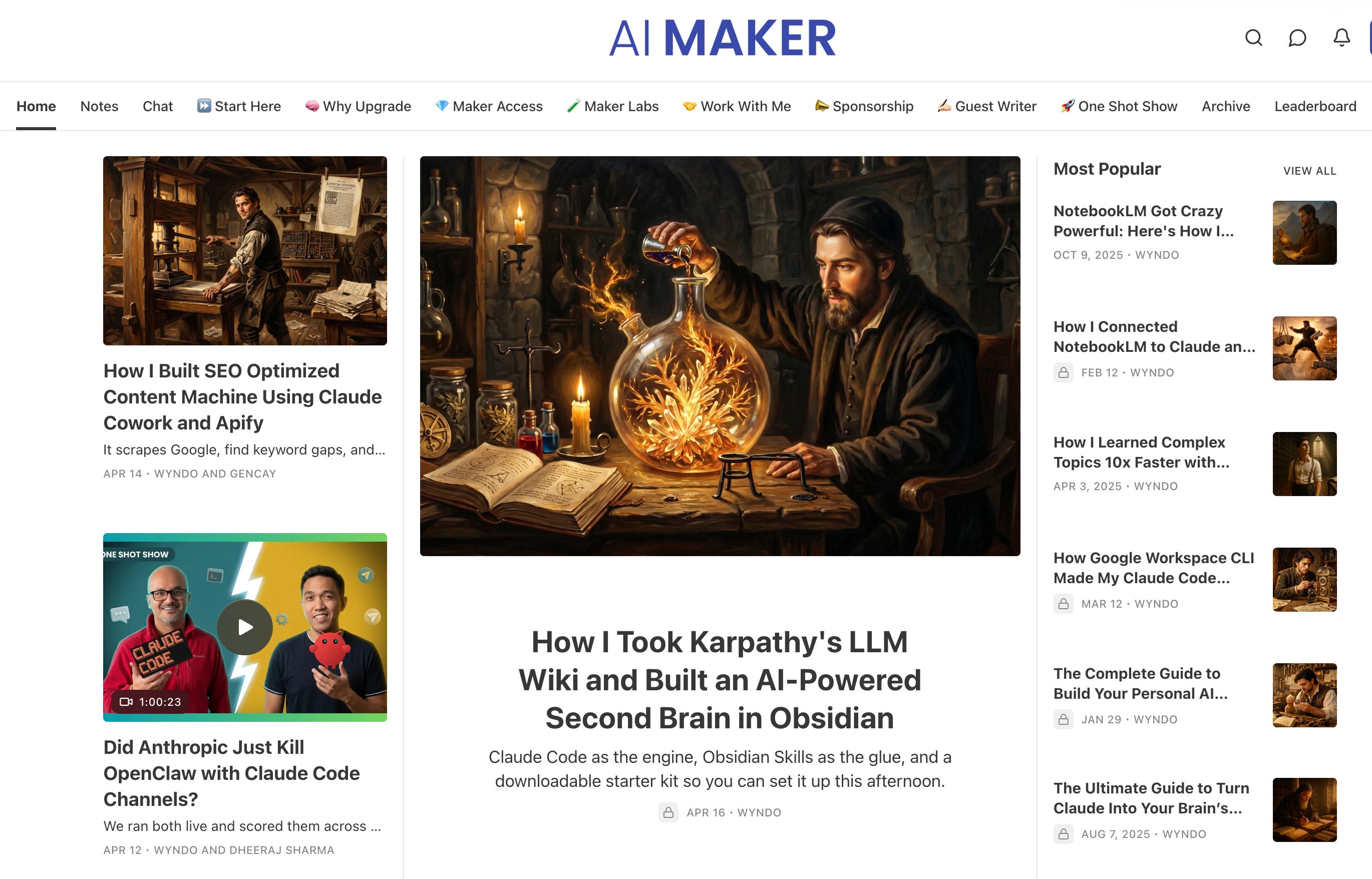
The use case: 50+ custom slash commands running an entire content pipeline.
Wyndo has built over 50 custom slash commands and skills. Together, they handle everything from brain dumps to polished social posts, from newsletter repurposing to multi-persona draft reviews before publishing.
His favorite workflow is /brain-dump-to-social.
He rambles unfiltered thoughts into a daily note. Claude Code transforms them into platform-ready Substack Notes that match his voice.
In his words:
I run a Substack newsletter called The AI Maker, and Claude Code is basically my entire content production system. I've built 50+ custom slash commands and skills that handle everything from turning raw brain dumps into polished social posts, to repurposing newsletter issues into LinkedIn posts and Twitter threads, to running multi-persona draft reviews before I publish. My favorite workflow is /brain-dump-to-social, I ramble unfiltered thoughts into a daily note, and Claude Code transforms them into platform-ready Substack Notes that match my voice. Zero coding involved. I just write in markdown files and let Claude Code orchestrate the whole content pipeline around me.
The key phrase is to orchestrate the whole content pipeline.
Wyndo isn’t using Claude Code for one task.
He’s using it as the operating system for his writing business.
Markdown files in.
Platform-ready content out.
3. Joel Salinas — Leadership in Change

The use case: A personalized industry briefing delivered every morning.
Joel isn’t a coder. He runs a leadership and change consultancy.
But every morning, he gets a custom briefing built entirely in Claude Code.
The briefing summarizes the biggest AI news from the past 24 hours. It pulls new YouTube uploads from his favorite creators.
Then it suggests angles he could use for leadership and change talks if he wants to cover any of them.
In his words:
I am not a coder, but I have been able to do some pretty amazing things with Claude code. One example that comes to mind is this industry briefing that I get every morning. It was completely made using Claude code, along with some connections within Claude code. It comes through and summarizes the biggest AI news from the past 24 hours, any YouTube video uploads from some of my favorite YouTube creators, and provides angles I could use for leadership and change talks about these if I choose.
This is the part people miss about Claude Code. It’s not just writing assistance. With a few connections, it becomes a research agent that reads the internet for you and filters it through your expertise.
4. Sam Illingworth — The Slow AI

The use case: A full educational game with 4,000 plays, built without writing code.
Sam built Flagged entirely through Claude Code. It’s a game where you play an assistant professor reviewing student submissions that were flagged by an AI detection tool. You read each case, check the student’s file, and decide whether to flag or pass.
The point of the game is to show why AI detectors are unreliable and biased against marginalized communities.
In his words:
I built Flagged entirely through Claude Code. I wanted a game so people could experience for themselves why AI detectors are not only unreliable but also biased against marginalised communities. You play an assistant professor reviewing student submissions flagged by an AI detection tool. You read each case, check the student’s file, and decide whether to flag or pass. I am not a developer. I described the game design, the ethical dilemmas, and the twelve student scenarios in conversation, and Claude Code wrote every line of HTML, CSS, and JavaScript. It has had almost 4,000 plays on.
Sam didn’t write the code.
He wrote the concept, the ethics, and the scenarios.
Claude Code handled the rest.
This is what non-developer actually means.
Not “Claude Code writes code for me,” but “I design the experience, Claude Code ships it.”
5. Yevheniya — Mother Using AI

The use case: Turning raw thoughts into publishable Substack posts without formatting anything.
Yevheniya is a software engineer who stepped away from building products to focus on her family.
She wasn’t shipping code. She was thinking, observing, and writing small notes about AI and life.
Then she started using Claude Code differently.
In her words:
I take a messy idea like ‘AI is changing how we learn faster than we realize’ and I describe it in simple words. Claude Code helps me turn that into a clear story. A full Substack post. Something people can read, relate to, and learn from. I don't design anything. I don't structure manually. I don't think about formatting. I just think. I write. I reflect. Everything else gets handled.
What makes Yevheniya’s setup different from a ChatGPT conversation is the persistence.
Claude Code knows her past posts, her voice, her themes.
It’s not a one-shot writing tool. It’s a writing environment that remembers her.
6. Frank Andrade — Artificial Corner
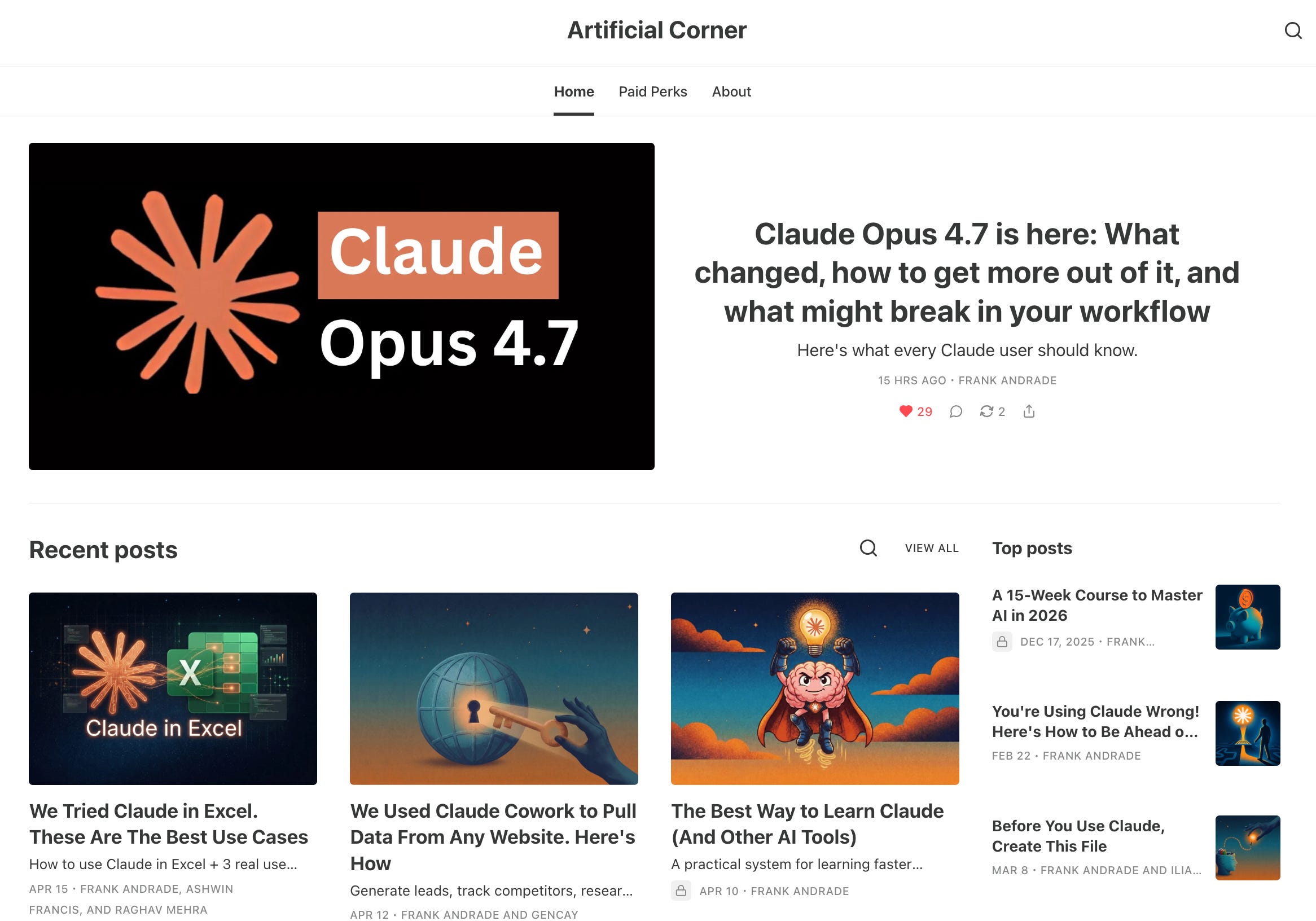
The use case: A full Substack Notes engine that turns input into ready-to-post Notes.
Frank built a complete content production system inside Claude Code.
It handles 6 different note families (from guide summaries to news rewrites) and produces platform-ready Notes from a single compact prompt.
The system runs on a layered architecture of markdown files: a claude.md that defines the engine’s identity and operating principles, a voice.md built from a 485-line voice profile interview, context files for audience targeting, guide routing, note templates, CTA libraries, and quality checklists.
In his words:
I run a Substack publication called Artificial Corner, and Claude Code is my entire Notes engine. I built a system of markdown files — voice profiles, note families, routing rules, templates, quality checklists, and boundaries — that handles everything from turning guides into short Notes, to rewriting viral news in my voice. I paste a link, pick one of the note types, and Claude Code generates 5 potential Notes that sound like me. Then I manually select the best and hit publish.
Notice the last sentence. Frank still picks the winner. The system generates 5 candidates, and a human judges.
The bottleneck in content work isn’t writing the first draft. It’s knowing which draft is actually good.
The other thing worth pointing out is the 485-line voice profile. That’s not a prompt. That’s infrastructure.
7. Gencay (me) — LearnAIWithMe

The use case: A content performance predictor trained on 277 of my own articles.
Gencay built a Claude Code skill called MoneyTalks.
It reads any draft title Gencay feeds into it, runs it against 277 of his published articles, and spits back a prediction: expected likes, expected paid subscribers, red flags, and 3 data-driven alternative titles.
Before Gencay publishes anything, he runs MoneyTalks.
In my words:
I'm an engineer who taught myself to code long before AI. So for me, the building part was not the hard part. The hard part was the data work. Pulling every article's stats, tagging patterns, correlating likes with paid conversions, finding the real signals hidden in 3 years of my own writing. I found counterintuitive things. Tutorials get likes but rarely get paid subs. Project posts get half the likes but 4x the money. Time-based promises "5 minutes to X" boost shares but kill conversions. MoneyTalks is a frozen version of those findings. Every title I write is now judged against my own past before it reaches anyone else.
Notice how Gencay quotes himself like he's a different person :)
That's because MoneyTalks judges his titles like they're written by a stranger.
The skill isn't smart. It's just him, earlier, with no emotional attachment to the draft.
That's the pattern I keep seeing across all these setups. It's not about speed. It's about consistency without willpower. The system runs whether or not you feel like running it.
What These 7 Have in Common
Look back at the list. Ilia builds design systems. Wyndo runs a content OS. Joel reads the AI internet. Sam ships games. Yevheniya turns thoughts into posts. Frank runs a Notes engine with 6 families. I predict my own posts.
None of this is what Claude Code was marketed for.
But here’s the thing. Claude Code has two properties that matter more than its coding ability:
It works in your terminal with your files. Everything is markdown, everything is version-controlled, everything is yours.
You can teach it your taste. Slash commands, skills, and CLAUDE.md files let you bake your preferences into the system so you don’t repeat yourself.
Those two properties are why it works for writers, educators, consultants, and creators who never open an IDE.
If you’ve been avoiding Claude Code because you think it’s a developer tool, that’s like avoiding a kitchen because you think it’s for chefs.
It’s a kitchen. You can cook anything in it.
What’s your use case? Drop your use case in the comments. If it's interesting, I might feature you in a follow-up.
 | A guest post by
|
 | A guest post by
|
 | A guest post by
|
 | A guest post by
|
 | A guest post by
|
awesome list!
there are so many things u can do inside of claude code. In fact, you can also running an entire company within it.
it's just so wild to me imagining possibilities here!
Always love to see how other people are using the same tools in using, especially on the platform and (some of them) in the same field!
Amazing article!